In an epic battle of the bots, 19 First Tech Challenge robotics teams from Seminole, Volusia and Brevard County fought to be one of the five schools who advance to States. Hagerty hosted the competition in the old gym Feb. 7, and each team competed in six matches, before a double elimination round, after which winners competed in a semi-final round before advancing to the final match.
The team is split into the Metamorphosis—the robotics equivalent of junior varsity —and the Mechromancers—the varsity equivalent. The Mechromancers won the reach award and the Metamorphosis team won the control award. Neither team qualified for states, as the Mechromancers placed sixth overall and Metamorphosis placed seventh.
“I’m pretty nervous, especially since it’s my first year. I just hope our team can do well,” Metamorphosis lead engineer Zachary Culberth said.
The competition used one prompt throughout the year, and this year teams programed their robots to shoot different colored wiffle balls into designated areas. More points were given based on where the shot was taken, how many shots are made and other creative factors.
The Mechromancer team workshopped two main ideas for the design: One was a turret that would allow the robot to turn its head to shoot balls in all directions, and the second was a shooter with the ability to shoot three balls at once.
“At the beginning of the year, when the turret idea came up [we] 3D printed it. We tested it out [and it] didn’t really fit for our robot,” Mechromancer team member Ansley Dickison said. “Then we did the triple-shooter, it work[ed], so that’s how our robot is right now.”
The matches were two minutes in length. The first 30 seconds were the autonomous period, where the robots move based on their own coding, with intervention. Then, the majority of the match was the driver period, where teams used controllers to move the robot. The last 20 seconds of the match was the end game.
“[The most nerve-wracking part is the autonomous period], when your robot has a mind of its own,” Ansley said. “We’ve gotten penalties from judges for our autonomous not working properly, but we got it working now.”
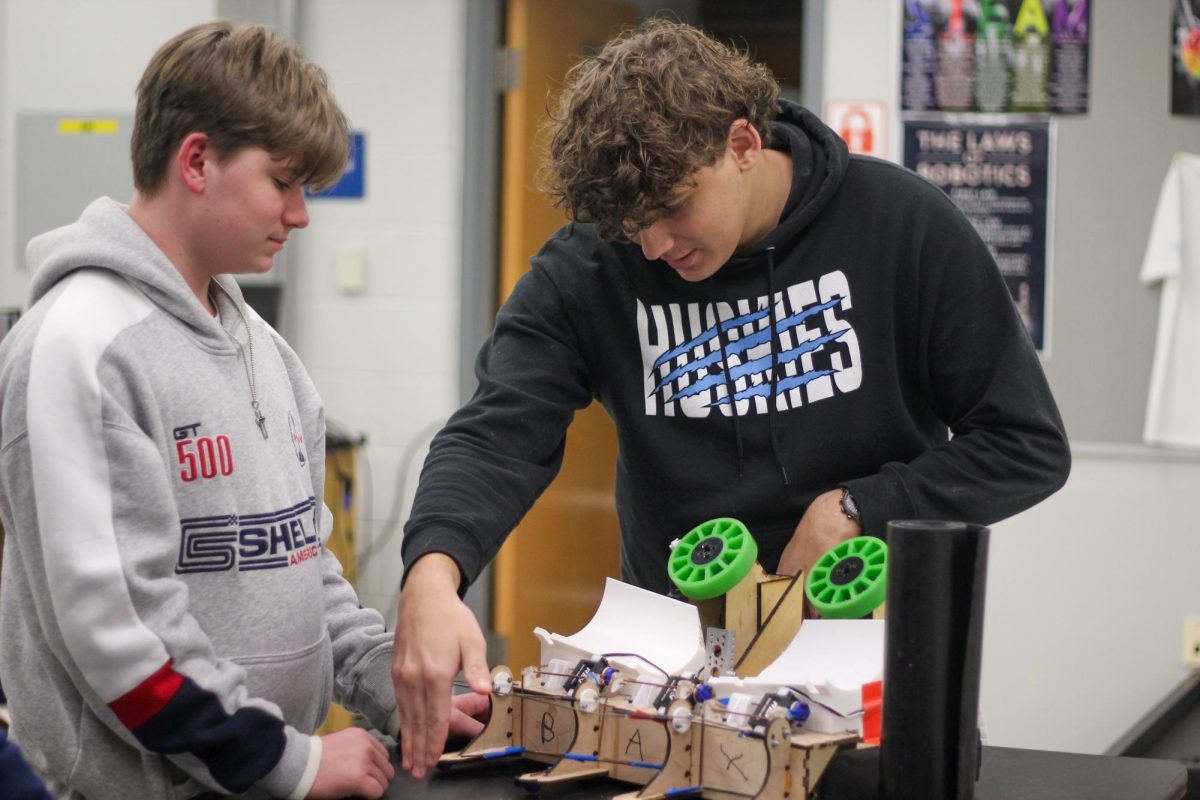
The requirements for the competition state that the robot cannot exceed 18 by 18 inches. On top of this, material is a large consideration in the weight and durability of the design. The Mechromancer team has a robot made from carbon fiber, which is more durable, while the Metamorphosis team decided on wood, which is more lightweight.
“We had a lot of challenges, especially with the weight, because we made it too light,” Culberth said. “So it [would] drift when you were driving it. Other issues we had was the height and length… We’ve been all over the place.”
Decisions around size and material can make a major impact on how the design functions during the match.
“It definitely is nerve wracking, just because it can affect everything,” Culberth said. “If even tiny pieces like a screw [are] missing, it can mess up the whole thing. [This is why we] lost a competition.”
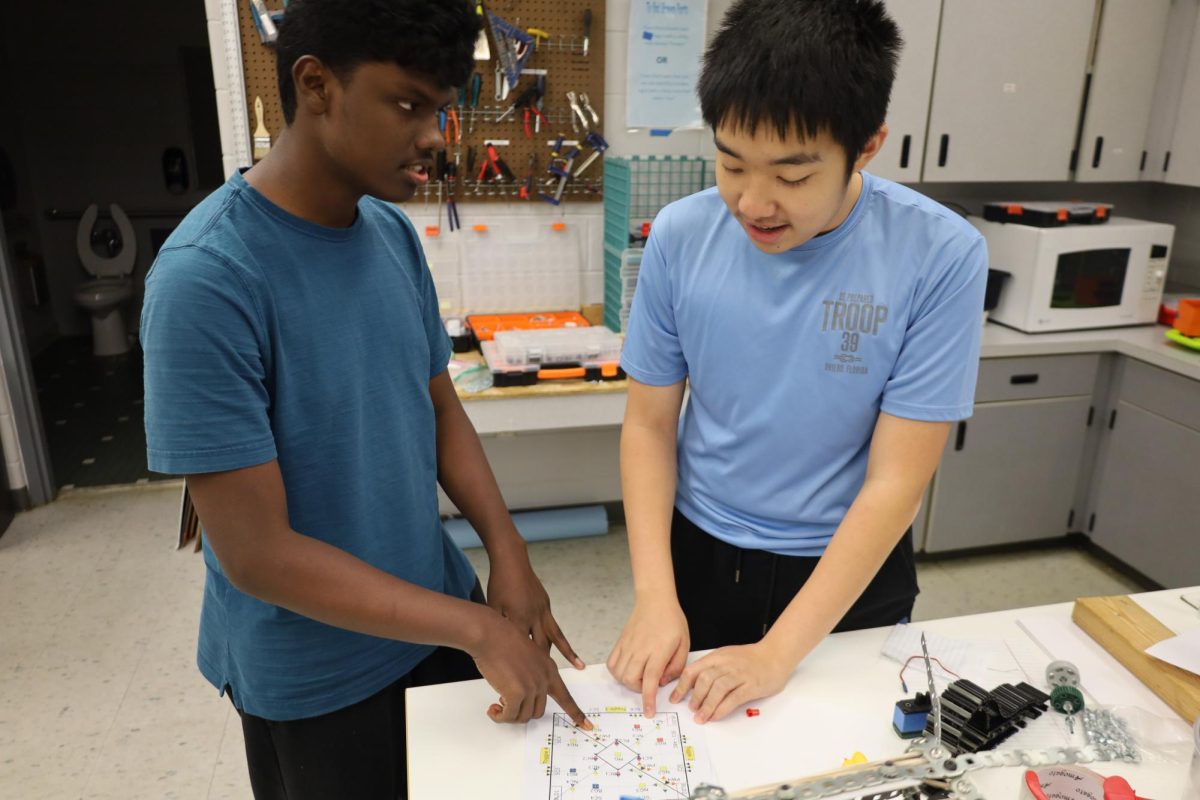
Another key aspect in the competition was presentations outlining their process, outreach and other notable details. The presentations were a team effort, with different members writing about programming aspects, editing the wording and drawing visuals. Teams also uploaded digital portfolios for judges to review in addition to the five-minute presentation.
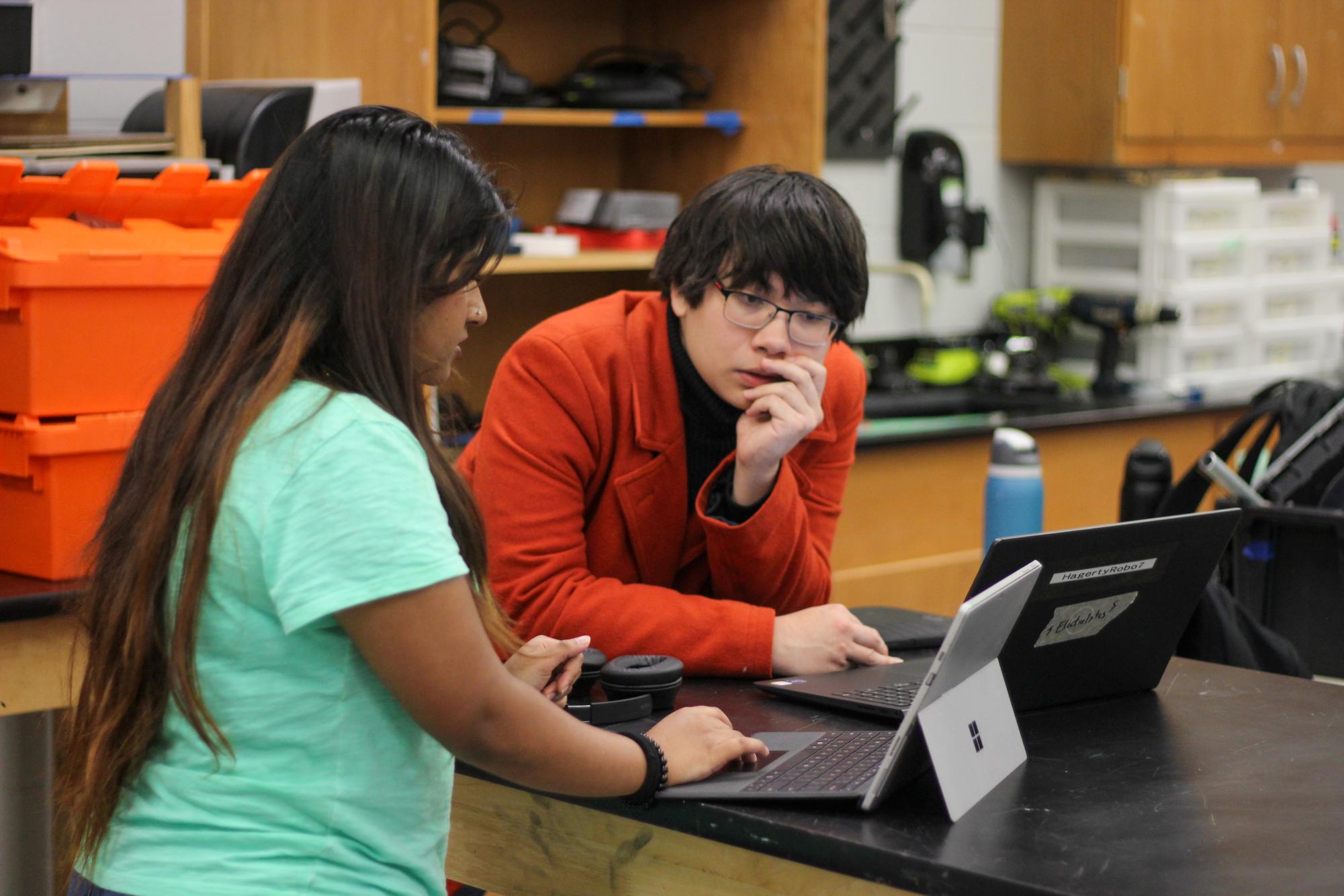
“It’s truly a team effort. It’s not just like one person,” robotics instructor Po Dickison said. “We want our kids to get that experience of basically being a very well rounded individual. So you’ve got to be able to present and speak in front of people.”
Teamwork was emphasized in the program for a reason, as it is essential for brainstorming designs and managing the robots throughout the competition. To further build camaraderie, the team makes an effort to support each other throughout important competitions.
“We openly talk about our feelings and how nervous we are, and we just respect each other, we talk about it and let them know, like, how we can help in any way,” Ansley said. “If you need to talk, we’re here.”
This is a competition that Hagerty hosts yearly. They must manage sponsors such as Lockheed Martin, work with volunteers, set up the competition space and design little gift bags for the competing schools.
“[There is] a lot of preparation, especially since we’re hosting it, and it is one of the biggest events that we have,” Ansley said. “It’s definitely stressful when the time comes around, but we always make it work.”