*DISCLAIMER: This article deals with topics that may be intense for some, including medical emergency, suicide, drug use and child neglect/sexual abuse.
This is 911, what’s your emergency?
Those are words no one ever wants to have to hear. Yet, everyday hundreds of people find themselves in a position where they are in need of emergency assistance–and every day first responders are there to help.
Do you want fire, police or medical?
First responders are people who are tasked with arriving immediately to a scene and taking care of those in an emergency, including police, firefighters and emergency medical technicians. Each type specializes in handling different types of emergencies, and all of them serve a vital role.
First responders have some of the highest rates of mortality in any profession, both from the risks taken on the job and from the stress it causes their bodies. Yet, the job is an honor, as first responders get to aid people when they are at their worst.
“I want to help my community,” Hagerty graduate and former EMT John* said. “I actually grew up not wanting to do this job. I had a really tumultuous childhood, and so did a lot of the people around me, and none of us had anywhere to go. But that job kind of gave me the ability to be that voice, and that light, in a way for other people that were going through stuff I did.”
Emergency Medical Technicians
On the job, John worked to provide patients basic life support. This includes shock management, stopping primary bleeding, getting oxygen flowing, attaching 12-lead electrocardiograms (a machine that records heart activity) and starting the LUCAS machine, a portable device that delivers automated chest compressions to those in cardiac arrest. EMTs are often accompanied by a trained physician, who can diagnose and treat the patient.
“My job is to make the life of the paramedic a little bit easier,” John said. “Basically, I would be getting everything set up, just so that way we can get from point A to point B with everyone still in the best situation possible. It’s a scenario-based job: I [could] never go into a moment telling you I was going to be doing oxygen or a 12-lead. I couldn’t tell you if I was going to go into a lift call, and that lift assist is suddenly a code, and I’m putting a LUCAS device on someone.”
John trained to be an EMT at Seminole State right after graduating high school. His classes were split between class days, where trainees learn the skills necessary for success, and lab days, where the skills are practiced.
“[For] the lab, you have to prove that you can do the skills, prove that you can carry through, prove that you have competency in it,” John said. “During a lecture, you’re learning straight out of a textbook. You’re going through a chapter a day. It’s really fast paced.”
Once classes were completed, he started working on clinicals, where he worked onsite with supervision during real emergencies. It is required that those in training work four 12-hour sessions for the fire department and four eight-hour sessions for the hospital.
“You help out nurses [and] with patients coming in from fire departments,” John said. “You’re learning how they do stuff, how they set up [and]what they do on the job. I learned a lot about the technology we use, and little shortcuts to make it a little bit more effective.”
EMTs respond to nearly 30 million 911 calls a year, where someone’s life could be on the line. A shift can take anywhere from eight to 48 hours, depending on the schedule of the worker. John responded to around seven calls every shift, with calls taking between one and two hours on average.
“I had some days where I was back-to-back-to-back calls,” John said. “I’m on the way back from a hospital where I just dropped off a patient. I’m out of my jurisdiction technically, and yet I got a call, and so I’m suddenly responding to a call in that zone.”
When approaching a scene, the first thing an EMT is trained to do is evaluate the safety of the environment. Then they assess from a distance looking for open wounds, deformities or a flail chest, where the patient breathes inward due to broken ribs. Next, they do a pat down and look for issues they cannot directly see, such as cuts or abrasions. Once they have a general idea of what is occurring, they ask the patient questions. It is important to get their entire medical history and recent activity. If the patient is unresponsive, medical history can be accessed on their phone by first responders.
“You ask open-ended questions,” John said. “You want to know every single thing you can so you know what’s going on and what’s maybe possible to treat. A situation we actually have had[was] ‘Hey, did you take any Viagra?’ Well, yeah, okay, I can’t give you nitroglycerin for chest pain, or else that will kill you.’”
It is important to an EMT to narrate what they are doing to the patient, so they understand what tests are being done and why. It is also important so medics can take notes throughout as to what is going on and better treat the patient.
“I wouldn’t say every medic knows better than you, but they might overlook something you’re seeing,” John said. “You’re a team. You bounce off of each other.”
The two types of situations EMTs treat are trauma situations that deal with external issues such as car accidents, and medical issues such as low blood sugar.
“[For trauma cases] You run treatment, and then you just want to get them either feeling better, or you want to get them to where they’re going fast,” John said. “It can be more complex to treat, however, but it is definitely easier to diagnose overall most of the time.”
Medical calls can be more complicated as there often is not a clear cause to the symptoms being reported. A wider variety of factors can impact their state, such as stress, sobriety or medical history. For instance, an individual could experience nearly the same symptoms for a heart attack as they do for a panic attack.
“It could be a million things,” John said. “And the other thing is, a lot of body systems run off of each other. It’s not even that. It’s a more complicated call. It’s just there’s so much more that falls under that category that you never really know what to expect.”
Regardless of the type of issue, transparency is a crucial part of the job as it allows for the professional to build trust with their patients.
“You’re supposed to be a trusted member of the community,” John said. “You’re supposed to be a secure place. You can’t lie to your patient. I can’t tell my patient, ‘Hey, everything’s going to be okay.’”
Firefighters
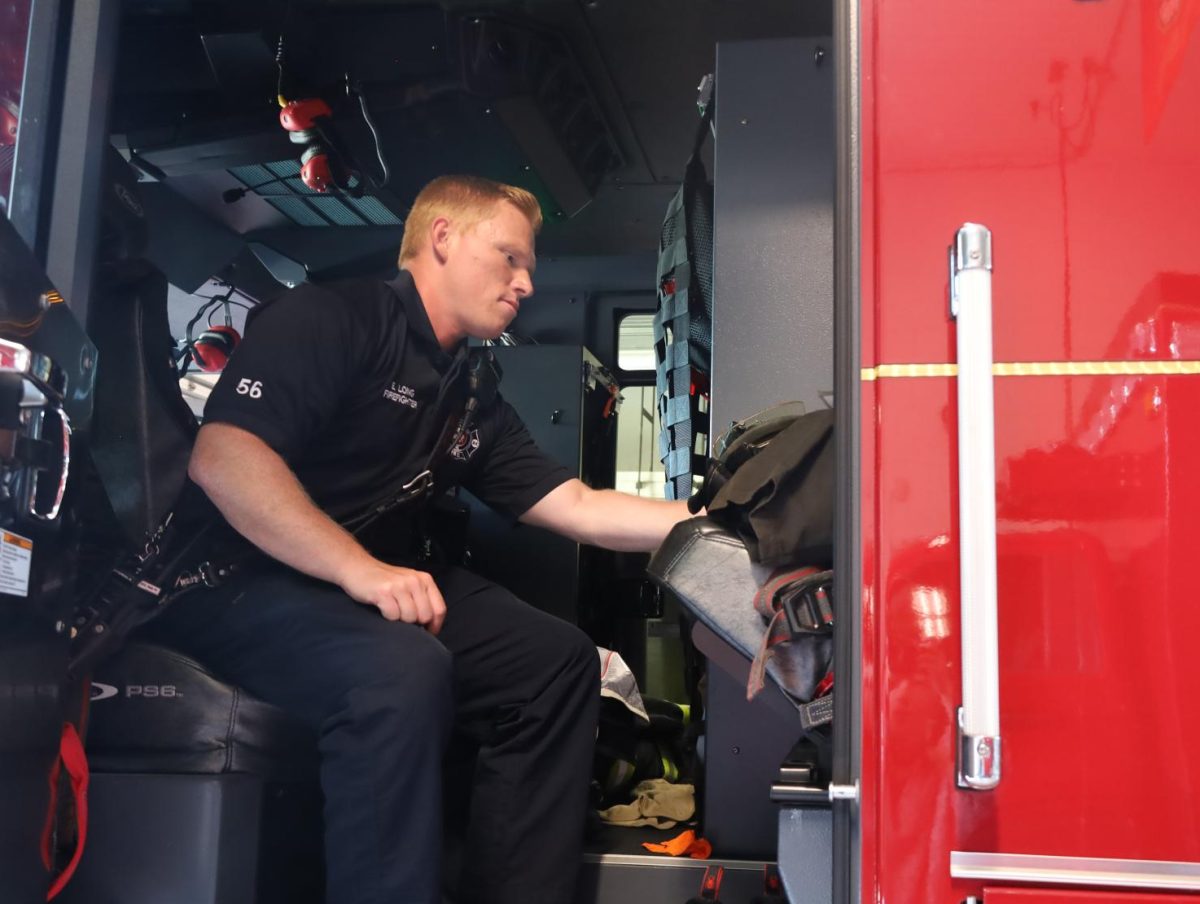
After graduating from Hagerty, Ryan Ellis attended EMT school before joining the fire academy, getting certified in both fields. The schooling to be a firefighter took six months to complete and went over all aspects of the job, such as handling the hose, how to force open doors and how to look for victims in a burning building.
After completing schooling, firefighters enter a year-long probation period before they undergo a six-month test where multiple chiefs come to evaluate their performance.
“Sometimes I’ve been nervous to do some things that I haven’t done yet,” Ellis said. “It [also] can be nerve wracking having them watch you or doing things on the job [or on] certain calls you don’t want to mess up on because people’s lives are at risk.”
Once on the job, workers also need to learn to adapt with the situation.
“There’s no cookie cutter call,” Station 48 Fire Lt. Mike Davidson said. “Every call is slightly different. So with that experience of seeing things go different ways sometimes, I think that it just kind of gives you an idea of what you need to do.”
An emphasised aspect of training is awareness of surroundings, as that is essential for both the safety of the worker and the victims.
“You just keep an eye on what’s going on around and what could potentially make it harder for us to accomplish our goal, whatever it is,” Davidson said.
Alongside the obvious task for putting out fires, firefighters are trained to also deal with hazard mitigation, fire suppression, search and rescue and highway accidents, which cause 10-20% of deaths among first responders according to the National Library of Medicine.
“I like helping people who’ve been in bad accidents.” Ellis said. “I like cutting cars up and getting people out of cars, popping doors and just really forcing using tools and things like that…people drive crazy. Firefighters get killed all the time by getting hit by reckless drivers or dealing with electricity and things like that. There’s not really a way to prepare for it other than [experiencing] it.”
Ellis works at stations 48 and 46 in Oviedo, on the same schedule that most firefighters in the area work: 24-hour shifts followed by 48-hour breaks.
“Sometimes it is a little rough,” Ellis said. “Sometimes you have a rough night at work where you’re running calls all night. [So] pretty much that whole next day, you [have] to sleep. But sometimes guys can’t, because they have kids when they go home, and they have to deal with their kids. But personally, I enjoy it [because it] gives you a lot of free time to do other things.”
In between calls, firefighters do training drills to stay in shape by practicing throwing ladders and all the skills mastered during their training period. There are also some more relaxed moments at the station, when they are not doing training or attending to calls.
“During the day, we’ll hang out and sometimes play some cards, or play sports, like we enjoy playing pickleball sometimes or even basketball,” Ellis said. “There’s times we hang out too.”
One newer initiative the Seminole police department has instated is community paramedicine. It was noticed that there were many patients who would reach out in crisis repeatedly, as they did not have access to resources to aid a problem before it started. For instance, if someone does not have access to a car, and thus cannot get their medication on time, the paramedicine program can help them gain access to a way to get their medication delivered.
“We have an aging community that we’re able to reach out and assist whenever they may not have assistance, or they may not know how to get assistance,” Davidson said. “We can provide them with that information and make sure you’re taking care of yourself. And if you’re not, we can help you get in touch with the right people to help you with that.”
Firefighters also do community outreach and tasks such as installing smoke detectors and educating the public on fire, especially children.
“We really want the younger kids to not fear firefighters and to know that we’re there to help them,” Davidson said. “It could be a scary situation that they’re in, and if they see us coming in the house that’s full of smoke, and start hiding from us, then it makes our job a lot harder and could be detrimental to their to the life if they get to a spot to where we can’t find them. So we want to really reiterate that we’re helpers.”
Firefighters deal with a variety of issues, including even medical ones, as many like Ellis are dual trained and they meticulously stock medical bags on their trucks.
“It’s nice being able to help people,” Ellis said. “Growing up, when I was little, I had asthma real bad, and every time I give someone a breathing treatment of Albuterol or Solu-Medrol [and] help someone give them that relief, it’s nice.”
Police Officers
Training for the police academy takes six months before officers enter field training that lasts four to five months. Many officers take classes on narcotics, undercover work and surveillance. Field training is divided into four phases, each lasting about 10-16 weeks. The first phase teaches basic vehicle training and paperwork, the second deals with filing reports and more technical training, the third deals with advanced patrol and problem solving and the fourth is a final evaluation where the officer is shadowed by a Field Training Officer, to evaluate how they handle situations independent of external help.
“For me, the hardest part was getting around, just because I wasn’t familiar with the area prior to working here, especially because I started on nights,” Sam* said. “I’d say [my favorite part is] the unexpected—waiting and seeing what we’re gonna deal with the next day.”
Sam has been on the force in Oviedo for three years and currently works day patrol, serving 12-hour shifts.
Officers frequently practice the skills necessary for their job. For instance, stations often host open range days for officers to work on their shooting, and scenario-based training occurs twice a year in Sanford. Police officers are trained to deal with first aid, traffic stops, animal complaints, juvenile complaints, mental health crises and criminal investigations.
“You never truly know what you’re [going to] walk into, so you just gotta stay alert,” Sam said. “Stay vigilant. Communicate with your co-workers. Luckily for us, especially my squad, we’re pretty good as far as backing each other up.”
While many picture cops investigating and arresting criminals—which is a core aspect of their profession—cases where individuals need external help due to a personal crisis are frequent as well. One report by the Center for American Progress suggests that between 29-39% of calls dealt with non life threatening issues such as mental health crisis, homelessness or substance use.
“We see people on their worst days, so kind of knowing how to approach it and how you can help them [is important]. Sometimes they just even need to talk, like they’re just in crisis,” Sam said. “They have nothing to talk about, no one to talk to, and they think that their life is over. I’ve gone out of my way to even go and buy someone clothing, food, just whatever they need. You never know the impact that that might have in their life.”
Any call made to the police has the potential to be dangerous; however, there are cases where the scene turns out to be more of a false alarm. This makes discernment an important skill for a successful officer.
“A lot of people run their mouth,” Sam said. “A lot of people just call us because they’re arguing. Other times, obviously, we’re there for a lawful reason, and they don’t cooperate. We make them cooperate, so we got to go hands-on or detain them for the time being, until they calm down and can kind of figure things out.”
Criminal investigations are the most serious cases, including fraud, narcotics and homicide and can last anywhere from a few days to years. Officers can get assigned to temporary duty assignments where they work on a case for two weeks to a month. Often officers work with detectives to collect evidence and follow leads.
“[I like when] I have an investigation where I can work from start to finish,” Sam said. “If you actually catch the person, that’s just satisfying… Each call is different depending on the crime that you have. Obviously, there’s calls [that] are a lot harder, especially with like child sexual abuse—those are a lot harder on us than just a normal fraud or anything like that.”
The process involves collecting evidence at the crime scene, if the case presents one. This can range from DNA samples to signs of forced entry. Officers interview the suspects and look for inconsistencies. After compiling the evidence and creating a report, detectives often step in to conduct an in-depth investigation.
“[Detectives] lean on us for assistance, as far as what we gathered from the moment we met with the person,” Sam said. “If you have leads that you want to work, [your sergeant] won’t say no. A lot of times [if] I want to work a case and I don’t have all the resources that the detectives do, they’ll help me with it.”
After the initial compiling of evidence, the bulk of an investigation is often conducting interviews. They usually take place in a designated location in a local police station, but can take place at the scene of the crime or even in one’s own home. During the process, the officer will corroborate the subject’s testimony with the evidence found, while noting other factors such as body language.
“There are three sides to the truth: there’s your side, the other person’s side, and truth,” Sam said. “You [were] not there, so you have to go based on each of their witness statements. That’s why we use surveillance, all of that, because that’ll kind of corroborate one person’s story. Sometimes you just can’t figure it out, and you just have to do what you think it’s best.”
Aside from determining truth and motive from suspects, interviewing victims poses a unique challenge, as the officer or detective must approach the situation with sensitivity, while extracting needed information. Building constructive rapport is important—humanitarian approaches that emphasize conversation and compassion tend to provide better results than dominant approaches, where questions are more direct. Officers must approach situations with care as recounting a traumatic event can often lead to further distress towards the victim.
“Especially for me personally, calls with children are a lot harder, and it’s how you approach the child because you need to have them tell you what happened,” Sam said. “Sometimes you have to sit there and play with them and just ask them certain things.”
With cases that deal with children specifically, police and detectives must coordinate appropriately as it is recommended children be interviewed a maximum of three times, since each interview forces the child to relive a traumatic event, and doing so repeatedly could cause them further harm.
“You gotta keep your composure,” Sam said. “If you’re not well, how are you going to make them feel like they’re okay? Once you leave or clear the call [you’ve] got to cry, scream, do what you’ve got to do after the fact.”
Another aspect of investigations is undercover work, which is reserved for investigations on a larger scale, often narcotic investigations or street crimes. Officers wear plainclothes and drive unmarked vehicles to collect evidence, often interacting covertly with persons of interest to obtain information. Sam worked undercover on an operation that lasted a month.
“You have to have your story straight [and] know who you’re dealing with,” Sam said. “[They also] take a lot of effort and energy. If you’re communicating with [a target] via phone, like while at home as well with your family, it kind of takes your time there, but then it’s rewarding [because a] small case can turn into something a lot bigger.”
With a job as intensive as police work, and assignments that can bleed through to other aspects of life like undercover work, it can become increasingly difficult for officers to balance the job with personal life.
“If you’re not giving your family and your home life the attention that it needs, it can obviously go bad just because you don’t want work to be the only thing that you’re always talking about or dealing with,” Sam said. “Sometimes if you’re trying to get to a goal [it] blurs out the line of work and home, but I would say, if you can get that handled, you’ll do well.”
The Cost
While most encounter a crisis situation only a few times in their lives, first responders deal with some of the worst situations imaginable every day, and they must keep calm through it all so as to not worsen an impending crisis.
“This could potentially be your patient’s worst day, and let[ting] them see how much it’s affecting you is only gonna make them worse off,” John said. “It can’t affect you. If you show that kind of weakness, that kind of insecurity, that scaredness around your patient, suddenly they’re going to doubt your ability.”
However, even with repetitive training and knowledge of how to act, there will always be situations that end in tragedy, which adds to the pressure faced by those in the job.
“[Sometimes] you’re not going to save the patient [and the call is] going to haunt you,” John said. “You’re going to doubt your skills, and to a degree, you’re going to doubt if this is the job for you. But at the same time, those situations make you realize how well you actually did.”
The skills that make an individual successful in an emergency-oriented job require maturity to be developed, especially to those who start the profession right out of high school.
“I got some buddies my age who are still hanging out partying. There’s nothing wrong with that, but [it’s] something I kind of grew out of a little bit,” Ellis said. “[I] got to grow up a little quicker, to be a little mature on the job, because there’s a time and place to mess around and [a] time to be serious.”
The often extreme level of stress dealt with on a daily basis has adverse health effects. First responders are five times more likely to develop Post Traumatic Stress Disorder than the average person, while police officers are 69 times more likely to experience cardiac death, according to the Functional Medicine Research and Technology Center.
“You’re told you’re never going to save them all,” John said. “But it’s also the really hard part about it if you know that. You know you’re not going to save them, but that’s not what eats you up. It’s not that I didn’t save this one. It’s something about the call that awoke it. So I’ve definitely had moments where I thought I didn’t do as much as I should have, or I could have done this better.”
It is both common and encouraged for people to take breaks from the job if needed, as the consequences of pushing through extreme conditions can be deadly. Over 46% of firefighters and 37% of EMTs report experience suicidal ideation, and 12% of firefighters report having made a plan to end their life at some point, according to the Cummings Institute for Health and Behavioral Sciences.
“There are certain calls that stick with you,” John said. “In my case, I had some childhood memories brought up for me during a call with a pediatric patient. Unfortunately, I could not save them. I kind of threw myself [into] a funk for a while. It was a rough period. I took a little bit of leave from the job to redefine myself.”
Taking time to decompress is important for those with high stress jobs such as nursing, police work and firefighters.
“You just have to learn to deal with it,” Sam said. “Luckily for us, we get provided with a lot of resources if we need it. Also, talking to your fellow co-workers does help a lot just because we deal with the same things. It’s a lot better than talking to your family just because they don’t know what you deal with on the day to day so they wouldn’t understand.”
While traumatic, helping others through the worst moments of their life not only builds camaraderie with fellow emergency responders, but impacts the community in a positive way.
“I’ve had patients that came from some situations where [they] used to reach out to where I worked and were like, ‘Hey, we appreciate what you did,’” John said. “When you can save someone’s life and they thank you for it, [and] when you see the multitude of other people that it can affect it brings you back into reality.”
*Name changed for legal reasons.