As you pick up your phone for the fourth time in the past five minutes, you find yourself increasingly annoyed by the “No New Notifications” pop up that taunts you when you swipe up on your lockscreen.
You open Instagram just in case. You know, sometimes notifications don’t deliver. That’s always a possibility.
Nope. Nothing in that notification tab either.
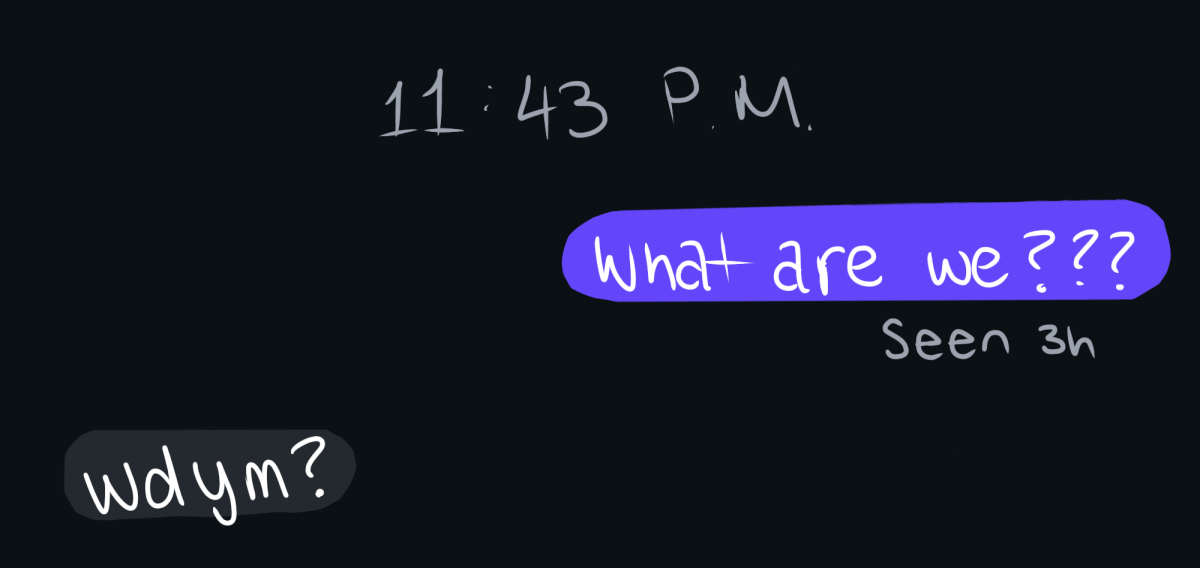
Time to check the DM’s tab, immediately you notice that the conversation at the top’s status has changed from “Sent 5h ago” to “Seen 30 mins ago.”
That feels infinitely worse.
You can’t even properly worry that in those 30 minutes they’ve been entertaining other people. After all, you’re not even officially together. But last night you guys were arguing over what color to paint your apartment after graduation, which was a joke… you think.
How can such an intense connection blossom while it feels like the majority of the time you’re left questioning if they even like you?
You stare at the “What are we?” text glaring at you from your side of the chat, and you can’t help but wonder…
What are you doing?
Defining Situationships
Often defined as “romantic relationships with no clarity or label”, ‘situationship’ describes a new label for something that has always existed, especially amongst young people. They can include intense emotional and physical connections, high amounts of quality time spent together and… perhaps their most defining characteristic: Low levels of commitment.
Though most committed relationships begin with a certain degree of uncertainty and unspoken feelings, the difference is that situationships stay in that phase, due to stalling from either one or both parties, who may or may not intend to move the relationship forward. And these intentions are usually not disclosed.
It can be hard to give a concrete definition to such an abstract concept, because no two situationships are the same. But the lack of clear-cut expectations, disregard for social norms and unexplained secrecy are common themes, especially among students’ experiences.
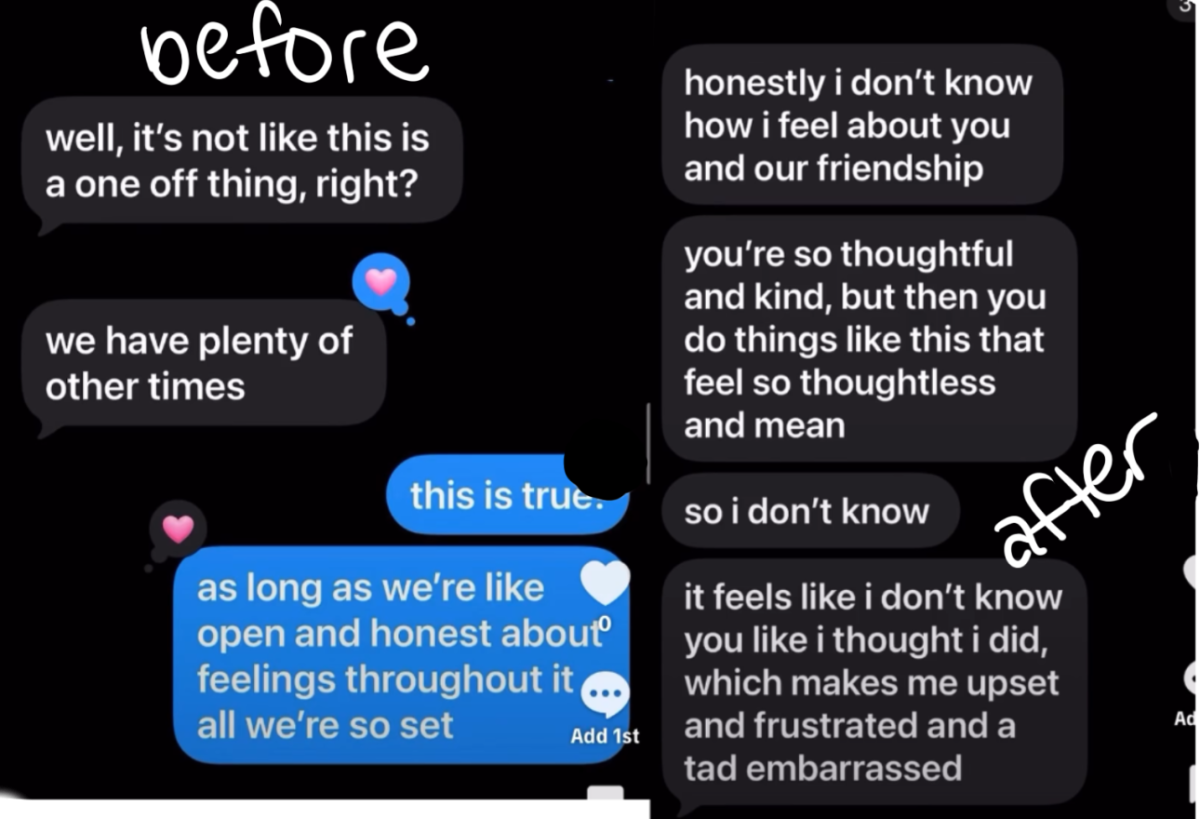
You may have discussed future plans, baby names, and had lengthy discussions about how life changing meeting them was, but somehow they’re always busy. Or every time you mention labels, your message rotted in their inbox for days…
The confusion and ambiguity comes with high highs and low lows, which is part of the appeal for many, but it’s also what makes them so confusing, and painful, to others.
“We used to tell each other we loved each other every night,” junior Josh* said. “But he never acted like he had a crush on me [in public].”
How They Start
For Josh*, his situationship started with someone he originally considered his best friend.
“We [first] became friends four years ago,” Josh* said. “Then, we started [catching feelings] like two years in.”
For him, instead of taking a traditional friends-to-lovers route where both parties are in agreement about how they feel and wanting to enter a romantic relationship, the transition was much more convoluted.
“We just needed to label it, but he was avoidant,” Josh* said. “He was scared of labels. I was scared of labels, too. I had never been in a relationship.”
This is only one way situationships can begin, some are not born out of insecurity or fear, but instead the ambiguity stems from intentional dishonesty.
“[I get into these situations because] I would think they’re genuinely nice [people], and then they’ll either be like, ‘Oh, I don’t have feelings for you anymore,’ or ‘Oh, I’m seeing another girl,’ when they [initially] said they weren’t,” junior Jane* said.
According to a study by Dr. Langlais, a member of the International Association for Relationship Research, people often meet their situationship partners through social events, common interests (like sports or theatre) and school.
Jane* met her situationship through a tennis program, senior Tiana* met both of hers through her school theatre troupe and sophomore Ally* even met one of her situationships in the school lunch line.
“He wouldn’t talk to me at school after we met, though,” Ally* said. “Later, I found out it was because he had a girlfriend and also other girls he was seeing at the same time that went to school with us.”
The Appeal
“He was a very private person,” Josh* said. “So, he needed to get to know someone for a very long time to feel any sort of romantic attraction, and I needed that experience in getting to know him, too.”
Many people see situationships as a low-stakes way to test the waters before actually entering a relationship. The emotional intensity is one of the things that differentiates a situationship from a talking stage, which is also a low-commitment precursor to officially dating, but usually comes with a more stable timeline and aligned goals for a future relationship.
Langlais’ study shows that even if the parties involved aren’t in a fully committed relationship, they are “for the most part, emotionally and [physically] invested.” This more intense connection can make it easier to get to know the person quicker, even if it comes with blurred boundaries and unclear expectations.
“It’s not dating; it’s more like [a] talking [stage], but you don’t know what they’re thinking, and there’s a lot more mixed feelings,” Jane* said.
Sometimes, not knowing what the other person is thinking is part of the appeal, too. Without specifically defining expectations, both parties can enjoy the connection for what it is without fear of rejection.
“Having the “what are we” conversation early on might’ve spared me from the pain of the situation as a whole,” Ally* said. “But, I liked [the girl I was seeing], and I wanted to hold on to that.”
Other times, people enjoy the freedom of the connection without the official title because it allows them to simultaneously explore other options while still experiencing many of the physical and emotional benefits of a relationship.
Especially in today’s technology-driven society, people feel like they have more options than ever before. Leading to the uprise in situationship culture and people’s decreased desire to commit to romantic relationships overall.
Because a large part of the appeal for many is their convenience, technology plays a large role in the creation and continuance of many situationships. This way, the connection can be as involved or distant as the parties want. There’s less pressure to answer texts or pick up phone calls, and that allows these connections to form even when there is a low level of commitment.
“Most of my situationships were online majority of the time,” Ally* said. “With one of them, we mainly just talked on Discord.”
The Drawbacks
Though the potential freedom of situationships is a positive for many, recent studies show that most situationships do more harm than good for the parties involved. The same thing that makes them so appealing, the lack of commitment and presence of romantic connection, makes them painful.
Defining and Describing Situationships found that a common characteristic of situationships is that “one participant [often] wants more from the relationship than the other” which leads to conflict down the line.
“In my experience, they never lead to anything,” Ally* said. “Even if you try to, it doesn’t.”
In Ally’s* situation, the other parties in her situationships had been unwilling to commit, while she had hoped for something more. Though this mismatch in expectations could be avoided through communication, that opens the door to judgement, rejection and losing the connection overall.
“I just get nervous about being judged, that’s why I think I avoid the [‘what are we?’] conversation [on purpose],” Ally* said.
According to an article published by Vice, undefined connections leave people more “in [their] own minds, […] fantasies, projections and anxiety” which can be destabilizing for many, as the ambiguity of these connections is often associated with characteristics such as hypervigiliance, poorer wellbeing and lower self-esteem.
Furthermore, the role of technology can make holding situationship partners accountable feel difficult. Many students felt like the other party was unreliable, and gaps in communication were evident.
“He would text me, like, every four hours and ask me about my day,” Jane* said. “Then we [would] text for maybe two minutes straight, and then he disappears again for another four hours.”
The Aftermath
After such an ambiguous experience, many find themselves confused as to how they should feel. On one hand, it may feel counterproductive to grieve something that was in many ways unfulfilling. But on the other hand, sitting with unanswered questions and romanticized potential feels unbearable.
Many situationships lack a clear ending, as the party that is less emotionally invested may feel little to no moral obligation to provide clarity to their partner when they leave due to low levels of commitment. It can be awkward to end things, because even that requires labeling the situation in some capacity.
“It was 100% hard to come to the conclusion that I was done waiting for him to make up his mind,” senior Kay* said. “I was sad for the week after [it ended] because it’s not that he was doing anything wrong in particular, but I just knew the situation wasn’t right as a whole.”
There’s a scientific explanation for the vague sadness felt after a situationship ends. The lack of clarity actually makes it more difficult to move on, because regardless of the absence of a title, the brain often still registers the experience as meaningful.
And when reflecting on this “meaningful” experience, the mind runs in circles due to the lack of closure and absence of “concrete experiences and definitive relationship patterns”. For this reason, our brains can get stuck on grieving the perceived potential of the situationship and attempts to “solve” the undefined situation.
“To avoid the confusion, make sure the person you’re with is upfront about their intentions before you get in too deep,” Jane* said.
———–
So where do you go from here?
You have that awareness deep down that it’s not going anywhere, or maybe you’re still unsure, but either way you feel like you’re too far in to make a change. But at the same time, you also don’t want things to stay the way they are; you care too much to endure the uncertainty any longer.
Both ending it entirely and expressing your desire for a real commitment involve direct communication, and how are you supposed to do that if the gaps between messages are only getting longer and longer as time goes on?
“You have to know your boundaries and what you want, and find out the best way to tell them that you want more than what you have right now,” Josh* said. “How you do it really depends on the person.”
There may be no way to avoid the difficult conversation entirely, but the pain of knowing where you stand allows you to either heal quicker or start building a more stable relationship. Everybody deserves more than waiting hours, silently confused, just to experience human connection.
So, no matter the outcome, at some point it all boils down to the essential question: ‘what are we?’
What’s the worst that could happen?
Students’ Situationships