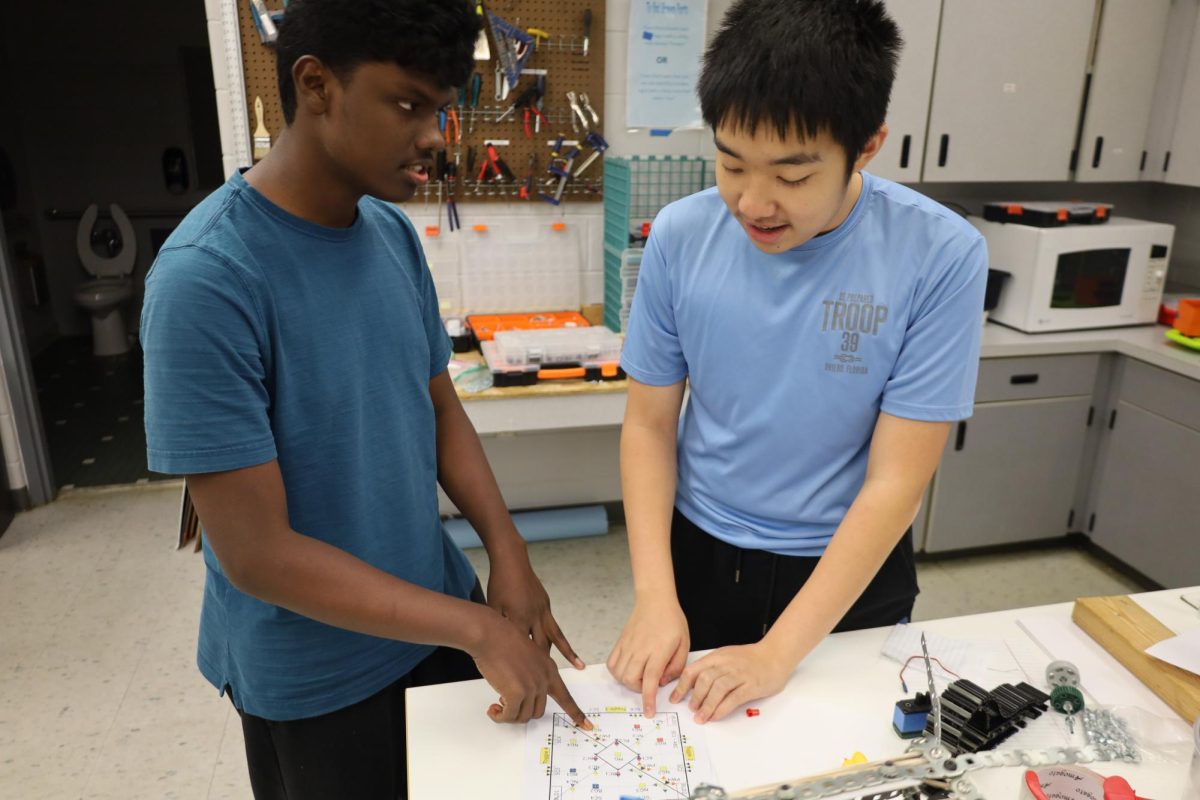
Picking up and stacking pins and cups. It sounds easy, but when you have to program a robot to do over 119 of these tasks, things get much more difficult. On April 24, Vex Robotics released the challenge for the 2026-27 schoolyear. Upcoming new challenges are not only a new opportunity, but also a new start for the team. The new game of VEX V5 is called Override, and in order to prepare, the team is already designing, building, understanding and preparing for their competition.
VEX Robotics is a provider of leading and educational robotics platforms, and its branch, V5, is for high schoolers, using more metal materials to help students practice STEM principles.
The new VEX V5 game, Override, is mainly about precise phase planning. The field will have pins to pick up, and the robots will use cups as tools, with one transparent side and one nontransparent. The color of the pins is important, as one way to score is to reveal the color of one alliance on those pins, and stackers will be around the field as base for those pins.
In Override, cooperation between the hardware and software teams is especially important because of the game’s precise objectives. Hardware members must design a mechanism capable of grabbing the irregularly shaped pins without dropping them, while software members program the robot to accurately line up with stackers and flip indicators at the correct angle. If either side fails, the robot can struggle during matches. A strong grabbing mechanism means little if the coding cannot position the robot correctly, while accurate programming cannot compensate for unstable hardware.
“You could have a good mechanism, but if it doesn’t really fit the game requirement, then it won’t work. That’s why you have to collaborate,” sophomore Ryan Han said.
Pins have different colors: red and blue, the team colors, as well as yellow. Teams can only pick up their color, and for yellow to count, players need to flip the indicator on the sides of the field. The technique for this game is that you need to control and flip pins and cups based on different situations.
“It’s interesting that in previous games you had more round objects, and this year’s objectives are irregularly shaped, so it’s kind of hard to pick it up,” Han said.
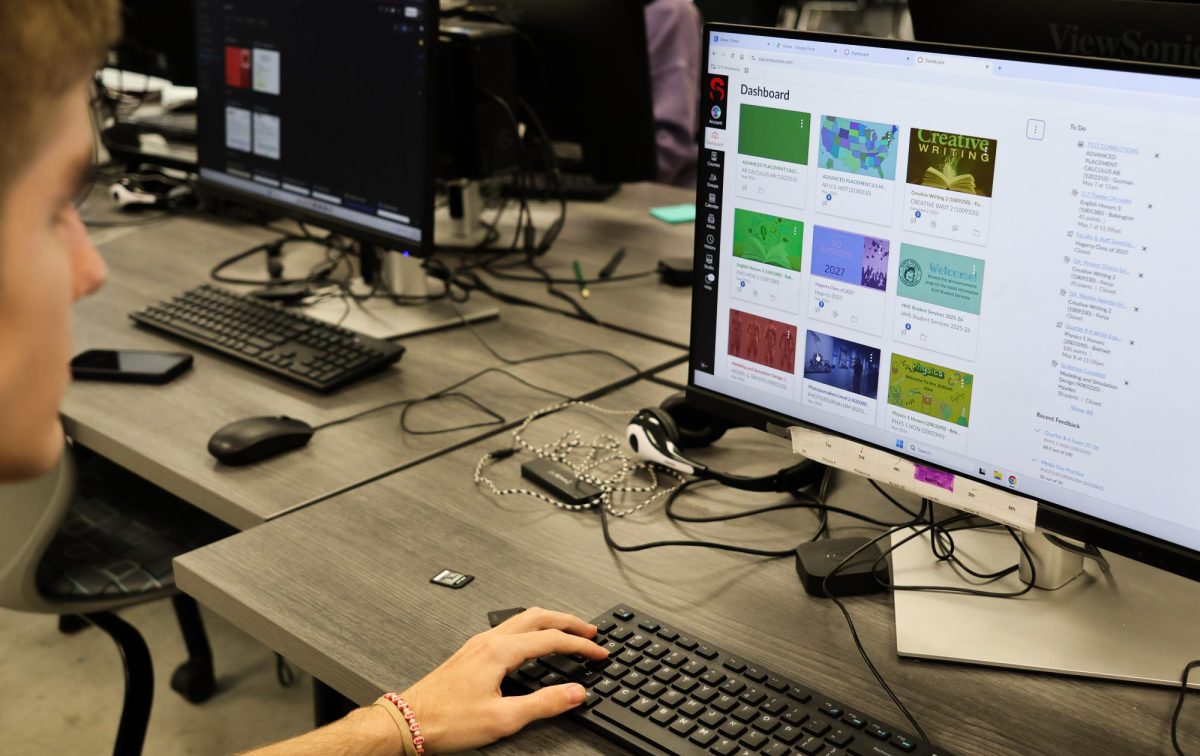
The Hagerty VEX Robotics team is made up of two groups. The hardware group, who creates the basic components of robots, building structures that aim to fulfill requirements for certain objectives, and the software group, who are coders of the robots, who mainly use C++ as the programming language, working on compiling the codes of robots to work as intended.
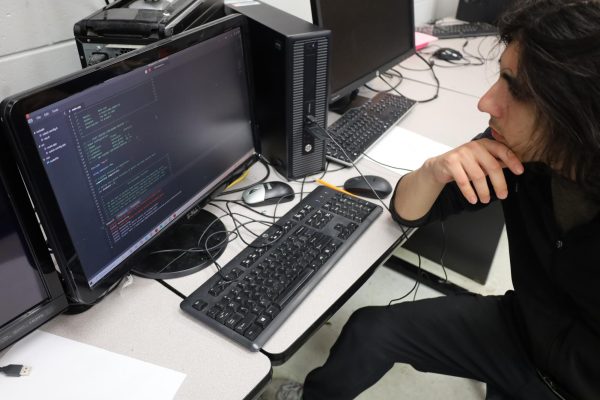
Han joined Hagerty VEX Robotics in his freshman year, when he first worked on hardware, but later began to study software.
“I think the hardest challenge I’ve probably done is dealing with that C++ compiler (program used to code),” Han said. “That compiler is a monster, it always gives you a bunch of errors, and then you have to debug it. It’s very problematic.”
His tutor for coding, junior David Bonet, has always been working on software and now teaches new robotics members to code. “The one skill I value is perseverance, because there are many challenges,” Bonet said, “For instance, when I was making the visualizer so we can actually see how the game works in 3D, there were a lot of issues, but you still have to maintain [it] to work.”
The official competition will happen in November, which means the team has a decent amount of time to work on it, including the summer. As for now, the team’s priorities are to read the manual and understand the game, and figure out a clear path to reaching the objectives. The hardware group will start, then when it gets to the first version, the software group will kick in, and from then on, both will work together.
The Robotics team is a community of innovation, learning and collaboration, and the new challenge will put these skills to the test.
“You don’t really need to be good at robotics. You just have to work hard and learn,” Han said.