Last week, principal Robert Frasca was visiting the “President Heads” museum in Williamsburg, Virginia. He gave Abraham Lincoln a high five, and asked him whether Lincoln and Booth had made up for their squabble. Lincoln replied that they have long made up, before hopping onto Ozzy Osbourne’s crazy train and rocking out with Queen Elizabeth in heaven.
“What do you mean it’s not true? I saw it on YouTube!”
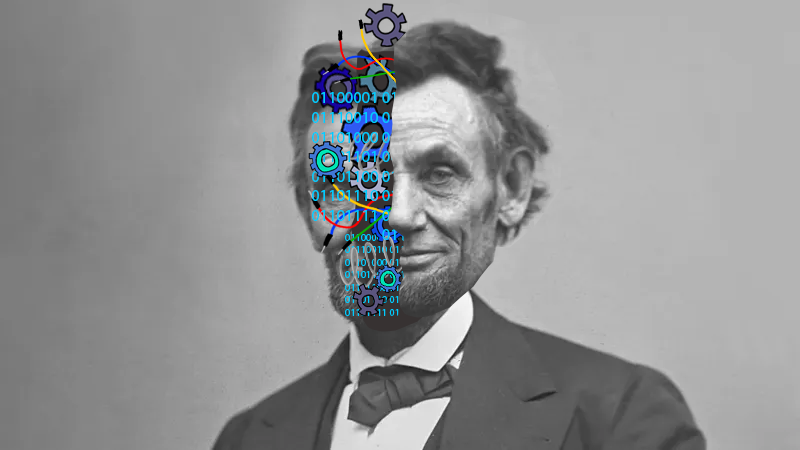
Creators have come to loathe Artificial Intelligence for trying to pass off human creativity as its own, but recently AI users have taken this replication one step further by reviving the dead.
The biggest target of this digital revival is Charlie Kirk. The rise of Kirkification began only 13 days after his death. On Sept. 23, 2025, Kirk was edited onto the face of the streamer IShowSpeed trying not to laugh.
Since then, he has been edited onto many more popular memes and photoshopped onto photos, and he even had an AI-generated song titled “We are Charlie Kirk.” Although the song at least was made with an intent to mourn him, it came off as a parody. While many are caught up in the humor of this trend, this new frontier of AI is far from funny.
Charlie Kirk is long dead, yet he can still be seen in the internet afterlife. For a lot of social media users, he is now more strongly associated with these memes than with what he accomplished in his organization Turning Point USA. Regardless of the varying opinions on Kirk, the use of AI to replicate him or any deceased person is a complex and possibly dangerous issue, and should not be swept under the rug as a simple joke.
Making AI-generated videos using a dead person’s face is disrespectful. Even if there is no malicious intent, there isn’t much justification for why using their face—especially without permission—is ever a good thing.
Imagine scrolling on the internet and seeing the face of someone you loved and lost etched onto a meme, their legacy and memory reduced to a few likes on a YouTube video.
In 2025, Robin Williams appeared in AI-generated videos with other celebrities such as Michael Jackson. His daughter, Zelda Williams, has publicly voiced her disdain for them, saying the AI videos sent to her were disrespectful, and not what her father would have wanted, worsening her grief.
When people use AI to replicate the likeness of dead people—even when it is done as a supposed means of “helping” or giving “tribute”—it is a bad idea.
On Youtube, Frank Sinatra is singing songs that definitely weren’t from his time period, including “Five Nights at Freddy’s” and “Creep” by Radiohead. With Sinatra’s voice appearing on YouTube pages all over, it would seem that he is more active than ever. However, at the end of the day, Frank Sinatra has been dead for years, and his singing career too. His voice is wonderful, but using it for YouTube profit is not.
Now that the trend has caught on, who is to say where the line is? Would it be fair to use XXXTentacion’s voice or Mac Miller’s voice for the Hagerty alma mater? No.
Using AI as a means to give tribute to someone is also a form of disrespect. In one trending post, Ozzy Osbourne appeared at a Rod Stewart concert, who was generated alongside Tina Turner in the clouds, perceived to be heaven.
Many fans were split about this, with some believing it to be a wonderful tribute and others believing it to be disrespectful. There should be no grey area, it is disrespectful.
And these videos are not just for entertainment. Jim Acosta, a former CNN white house correspondent, interviewed a deathbot of 17-year-old Joaquin Oliver. Oliver was killed in a 2018 school shooting in Florida. While his parents stated that it was a blessing to hear his voice again. The ethics of this are too muddy. What’s next? A company bringing back Grandpa to facetime and play yahtzee with you?
Replicating people’s faces for personal profit, humor or political gain is disrespectful whether they are alive or dead, but especially when they are dead.
There should be copyright laws set in place if people want to replicate other people’s faces without their consent, and there should be regulations to reduce the use of AI as a means to deface the dead. If these actions are not taken, we will be heading down a path with consequences even AI can’t foresee.