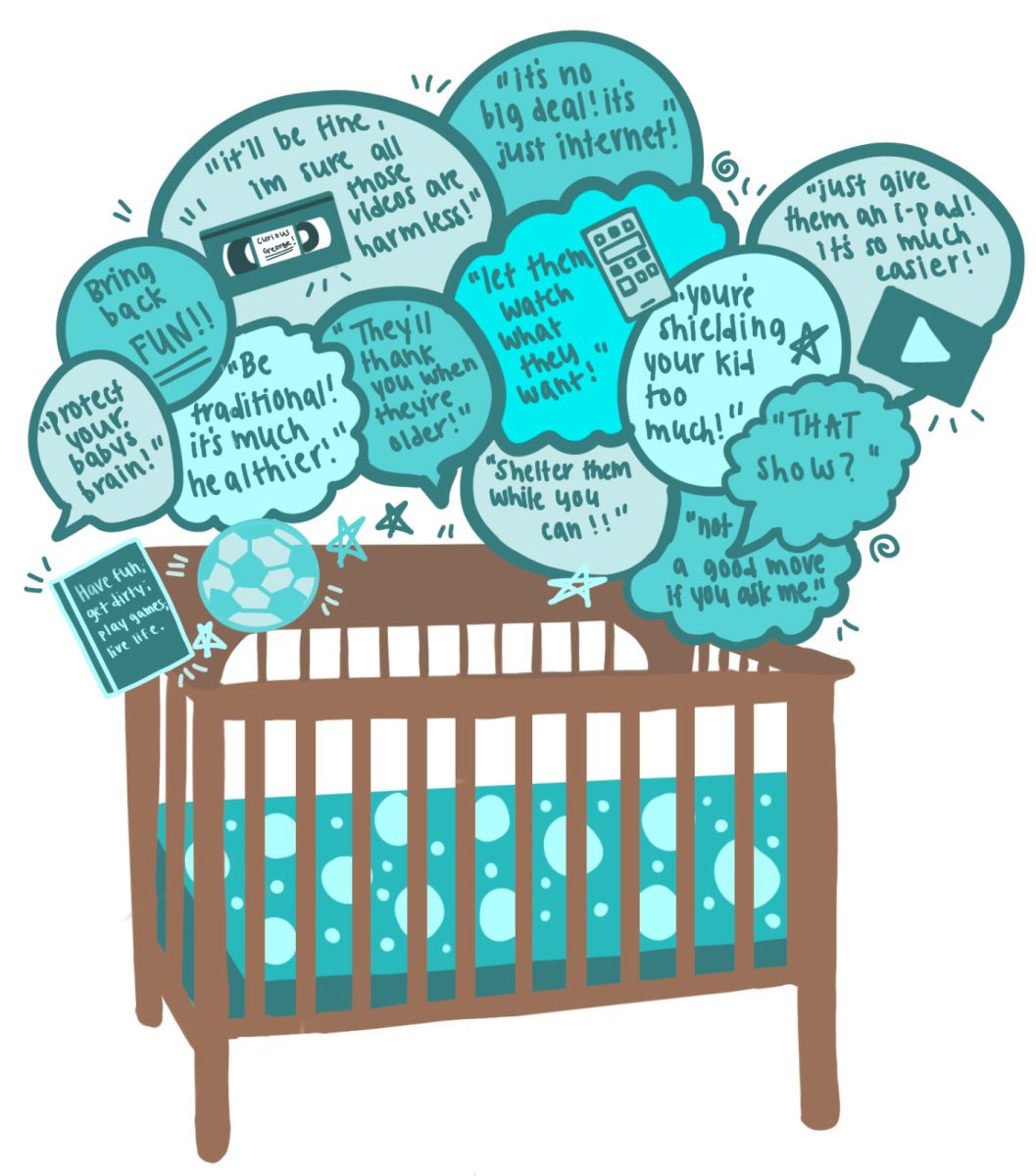
Childhood has lost its magic. Parents have stopped encouraging their children to go outside, make mudpies and get dirt under their fingernails, instead putting an iPad in front of their face to stop their whining in the middle of family dinner. When did we make the shift as a society from traditional childhood to not letting kids just be kids? As students who will be future parents, we need to be heavily considering how we are going to enhance the quality of life for the next generation.
I was born in 2008. From my experience, this was the prime of childhood activities and the best era to grow up in. I had a retro box television in my closet that only played VHS tapes; I had a CD player as my form of listening to music; I had a LeapFrog, not a tablet. There was no access to social media, and my main form of entertainment was playing outside: Jumping on the trampoline, riding a bike, playing pretend in the backyard or serving mudpies in a tiny playhouse.
Nowadays I rarely see this kind of activity from kids, though it was the norm just a few years ago. All of a sudden, most children have instant access to the internet and social media, and it seems most of our population has lost their imagination.
According to the University of Michigan Health C.S. Mott Children’s Hospital National Poll on Children’s Health, “nearly a third of parents say their child engages in media play, such as video games, and 3 in 5 say their kid watches TV or videos every day.”
This kind of behavior, no doubt, falls onto the parents. It is rightfully their responsibility to keep their children entertained (and it will be ours someday), and in this day and age parents seem to “opt-out” of being creative, instead taking the easy way out and letting their kids go buckwild with devices. I am sure many of us can say we have been to a restaurant and seen an entire family glued to their devices. Mom on her phone scrolling through Instagram reels; dad watching YouTube shorts on how to fix the kitchen sink; and the kids watching Cocomelon on their tablets. This is a sight I absolutely despise to see. In fact, it breaks my heart.
What happened to family game night? Why don’t we default to talking to one another at dinner and bond as a family? It is truly upsetting to grasp the reality that we as a society just aren’t as close anymore and families have become less functional.
Children’s shows have also become much less engaging, which is something that might not be heavy on our minds, but no doubt impacts children’s lives. We went from the most amazing shows like “Curious George” and “Blue’s Clues” to pure brain rot like “Cocomelon” and “Gabby’s Dollhouse.” Kids’ shows used to focus on slow paced, educational content that wasn’t repetitive and had a deeper meaning to teach children valuable lessons.
Now, most shows have become more fast paced, repetitive and dense with nothing of value for the kids to learn. The only modern children’s show that I would feel comfortable showing my future child is “Bluey,” which I think has a lot of those less modern elements like teaching a valuable lesson and non-repetitive content (probably because it’s an Australian show; America could never). It is important that we consider the kind of media we plan to subject our future children to, as it takes a toll on their brains and lives.
Mackenzie Westover, a clinical therapist at Loma Linda University, expresses her concerns about children having early access to devices, saying that because children are still developing physically as well as emotionally, they’re being influenced more when they are utilizing technology.
Parents need to get involved, and we need to be thinking ahead. Children should be encouraged to go outside; to explore on their own and not learn how the world works from a tiny screen that seems to have all of the information on everything at their fingertips. They need to be supervised but also assisted in learning valuable lessons and having fun. When you have children, you are automatically signing up for a full-time job. There is no “quitting,” and every single thing done as a parent matters to the child’s development and growth.
Consider the future. It might seem far away and irrelevant to think about, but it is not as far as we might think. In reality, some of us might be raising children in a few years, and there are so many things to think about and ponder as we go forward in ensuring the future is in safe hands.