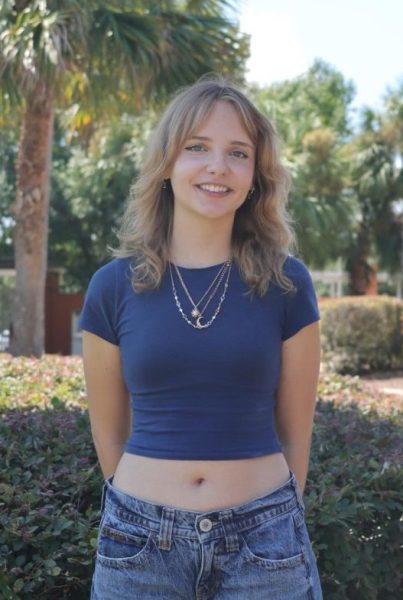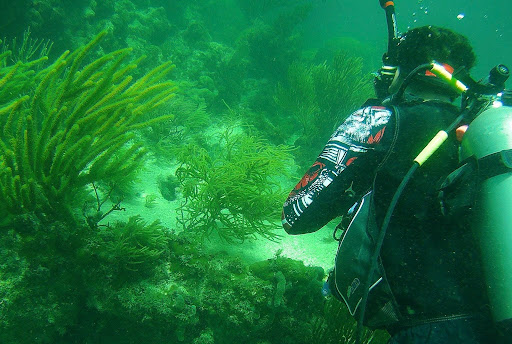
Many students spend their summers relaxing at the beach or swimming in their backyard pools. But junior Noah Kaplan takes it to the next level, descending beneath the surface of the ocean, exploring a world most people only see on their screens.
“I went scuba diving for the first time when I was 12,” Kaplan said. “I’ve always been a strong swimmer, I’ve had a lot of confidence.”
That confidence began early—taking a family trip to Egypt at age three and snorkeling in the Red Sea.
However, scuba diving requires more than just strong swimming skills. Kaplan completed a certification course through a dive shop, earning a Professional Association of Diving Instructors certification—one of the most widely recognized scuba certifications which teaches safe diving practices and gear competency.
“You don’t need a certification to dive, it’s not a requirement,” Kaplan said, “but it’s a safety precaution. Without that knowledge, you could die.”
Kaplan tries to go diving as often as possible, typically going on family trips to the Florida Keys or springs.
“Every summer [my family and I] go down to the Keys,” Kaplan said. “We rent a boat or go with a group. It’s always a great time.”
Despite the countless dives he has been on, Kaplan has one memory that stands out—when he and his family rented and lived on a boat for a week in the Florida Keys, going on 15 dives in the time he was there. During his time on the boat, Kaplan encountered a wide range of marine life. Both when on the boat and in the water Kaplan saw different kinds of fish, coral reefs and crabs, and even saw lemon sharks circling nearby.
For Kaplan, scuba diving has transformed into more than just an adventure—it has become a way to connect with nature and wildlife.
“It depends on the spot, and how active it is,” Kaplan said. “But most of the time, I see a lot of different animals. Especially if the visibility is really high, you’ll have a good time, interacting with all the wildlife.”
Experiencing different kinds of marine life has made his diving experiences exciting—no two underwater environments ever looked the same.
Kaplan believes living in Florida gives him an advantage. With easy access to both freshwater and saltwater, he can explore diverse dive sites without traveling far. Furthermore, the diverse ocean life—whether manta rays or dolphins—has allowed Kaplan to gain more experience in different conditions compared to those who do not live near water.
“It’s a peninsula, so we’re surrounded by water,” Kaplan said. “You can go anywhere, whether it’s to the ocean, springs [or] a lake. It’s got a lot of availability compared to other states.”
Despite the appeal, diving does not come without its unique challenges. Keeping track of your equipment is essential, but it can disrupt the fun.
“You have to make sure you’re not running out of air at all times,” Kaplan said. “You have to always check your equipment, even cleaning your goggles can be annoying.”
Furthermore, the cost of scuba diving is typically on the higher side. Averaging $300-$600 just for getting certified, and an additional $300-$1000 for gear, the price makes it a hobby Kaplan only does two or three times a year.
Regardless of these challenges, Kaplan sees scuba diving as something he wants to continue long into the future, especially as it opens doors to travel.
“I’d love to go to the Great Barrier Reef in Australia,” Kaplan said. “[Scuba diving] definitely makes me want to travel more, to swim in different environments.”