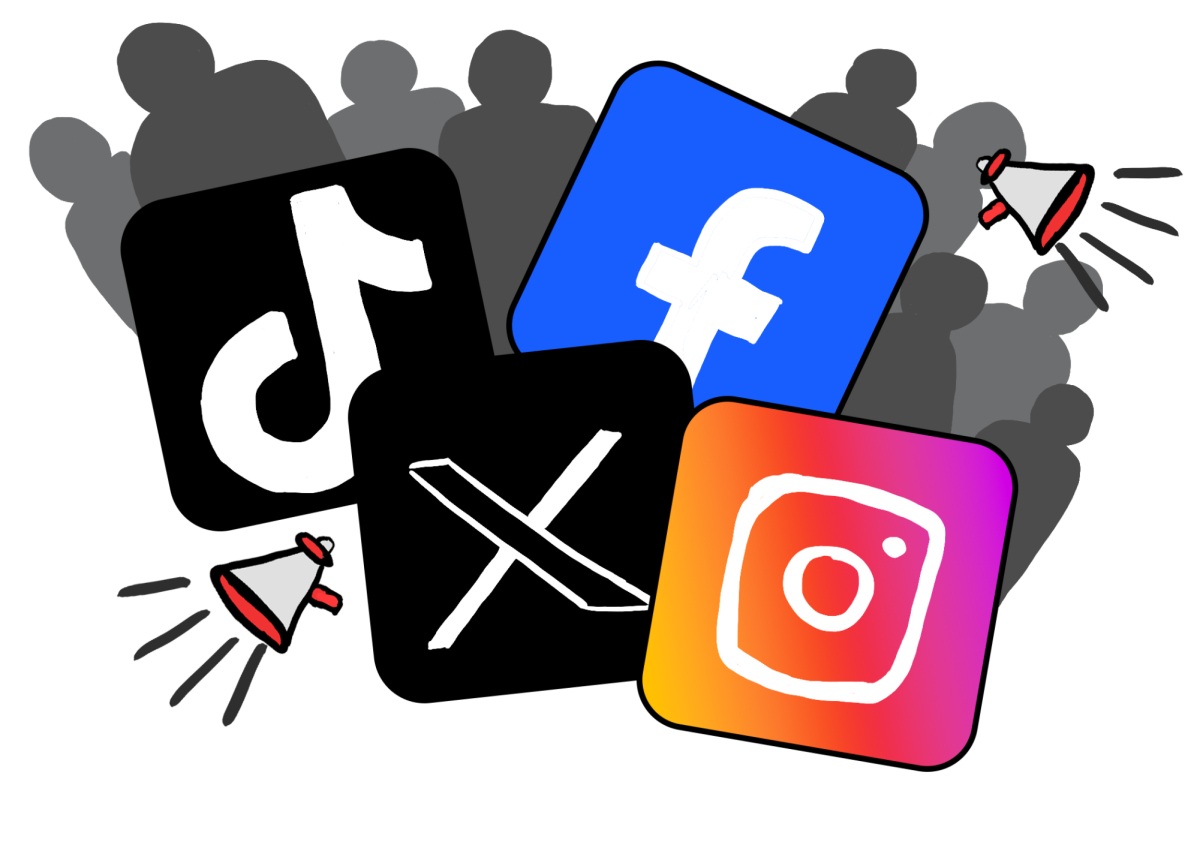
Since its inception, social media has connected people in ways never imagined. Online, people can share opinions, find fellow enthusiasts or show their daily life across the world. However, what started as a place to connect and even learn has changed—-social media is now more of a channeled amplifier than a supposed seminar for people’s opinions.
The spreading of brainrot, nonsense or even “niche” memes shows what social media has become—even though a lot of content seems downright nonsensical. While these specific cases are more silly than problematic, they still reflect the basic role of social media.
For platforms like TikTok and Instagram, there are countless trending sayings, but some of the most popular are the 67 meme and its branches such as 41, 61, W speed and its “brother,” “my mama’s kinda homeless” and dozens of others that are too cringy even to name.
These trends have two aspects in common that lead to one conclusion.
First, their spreadability. Almost all of them have a factor that makes them easy to reference. Their common pattern begins with a niche audience, before they start to spread into wider culture. Whether more people use them out of irony or genuine amusement, the result is the same.
Second, they mostly don’t have an actual meaning, leading them to cycle out at an alarming pace. They can just pop up and everyone knows it, then vanish to nowhere, completing their lifespan.
As always, if there’s demand, there is supply. There will always be people trying to duplicate a trend from a blueprint or forcibly creating their own, creating vicious cycles, and showing how social media algorithms promote worthless memes over those posts with meaningful messages.
While these trends are largely harmless, they reveal the underlying logic of social media: what spreads the fastest wins.
The problem emerges when this same logic is applied not only to nonsense, but to opinions. When ideas about politics, gender or identity are treated with the same algorithmic priorities as memes, social media does not encourage understanding. Instead, it encourages exaggeration. What begins as amplification quickly becomes distortion.
Queens University of Charlotte published a study oriented on how social media promotes extremism on its content, which defines the concepts of filter bubble (content selected by algorithms according to ranked user-provided signals) and echo chamber (information environments where users are only exposed to information from like-minded sources). Social media were never designed for you to see everything—they just use these mechanisms to keep you engaged on their app for profits.
The evolution of Twitter, now X is a perfect example. As politician Elon Musk took over, the platform saw a nearly 500% increase in use of the N-word in the 12-hour, and Tweets with the most engagement were overtly antisemitic.
“The Crowd: A Study of the Popular Mind (Psychologie des Foules)” fully explains why and how this phenomenon happens. The author, Gustave Le Bon, describes it as “the crowd psychology”: impulsiveness, irritability, incapacity to reason, the absence of judgment of the critical spirit, the exaggeration of sentiments and other effects.
Sound familiar? Social media has been doing this forever, but it has gotten worse over recent times, favoring louder voices over deeper ones, which can manipulate people to follow what they perceive as the beliefs of the crowd.
Overall, social media has merged into people’s lives. It connects people across the world, spreads ideas instantly and gives almost everyone a voice. This is not something that can simply be removed or ignored.
However, as shown through trends, polarization and crowd behavior, social media does not often lead to deeper understanding. It amplifies what spreads well, not what thinks well. Loud and simple voices rise, while more thoughtful or uncertain ones are often left behind. Since younger generations are growing up in this environment, they are likely influenced by these aggressive voices instead of reasonable ones.
As an individual, this is not a suggestion for abandoning social media, but for using it more consciously. In a space where something was chosen for you to hear, but not just benefiting you, be more aware of contents provided and understand if a content is only favored by algorithm or not. Also think about the polarity of social media, go through logical processes before conclusion.