Midway through the semester, a newly assigned teacher sits in a quiet classroom reviewing lesson plans and recent test results, realizing that the official pacing guide no longer matches the needs of the students in front of them.
Stepping into an established classroom requires quickly learning student expectations, academic gaps and routines—all while maintaining the flow of instruction.
Few realize how stressful it can be to start working as an educator. Education is often seen as a stable profession, but in recent years, employment of new teachers has increased in Florida, resulting from the positions filled by newly hired teachers. According to the Florida Department of Education, teacher vacancies have reduced 17.7% for the 2025-2026 school year compared to the 2024-2025 school year. While the trend has improved, there are still a lot of positions that go unfilled, and at Hagerty, several classes got new teachers at the beginning of the year or even midway through the year.
These new educators often experience an adjustment period where they have to face the challenges of the classroom, especially during the first few weeks, with their new class environment, students’ expectations and new course material to adapt to. This results in a lower education quality compared to experienced teachers, and difficulties on the teacher’s side.
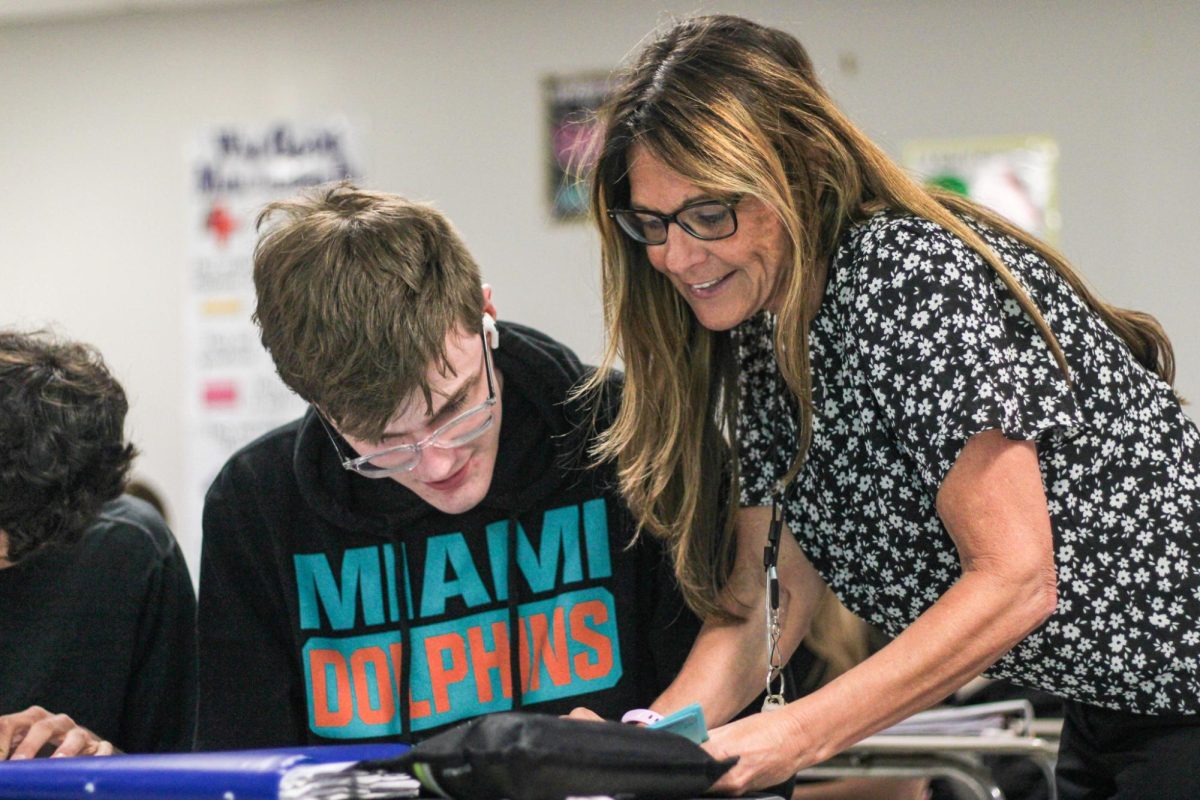
One major challenge when teachers get introduced mid-year is student expectations. Elizabeth Maxwell is a substitute teacher, and was assigned as the Algebra teacher for the semester due to previous teacher Tammy Brown leaving.
“[I] didn’t get to start the year with them, and that’s hard,” Maxwell said. “[If] you start the year with a group of kids, your expectations and their expectations are the same because you’ve set the standard.”
Starting the year with students is important for setting and adjusting expectations within the classroom. It is not a small problem: when teachers face challenges, even classroom management-wise, it can result in inefficient teaching that could negatively impact students.
Despite these challenges, Maxwell continues to seek support from experienced colleagues. She regularly communicates with other math teachers, including Aglaia Christodoulides and Gian Tucciarone, and observes their classes to improve her own teaching strategies.
“[They] gave me so many pointers and tips,” Maxwell said. “I will go and sit in on some of their classes, and see how they talk and teach the material.”
Reflection is another aspect that is essential for the success of new teachers. Computer Science teacher Benjamin Ross made several changes throughout his first year, improving his teaching based on his own observations.
In Computer Science and AP Computer Science classes, Ross would initially expect and rely on students to know all the courses essentially just by themselves.
“I realized that there was a mistake in relying on the students’ own efforts and [hoping] that they knew it themselves,” Ross said.
As in Ross’s experience, reflections are seen as one of the major skills required for teachers, to think back and learn from their experiences. It could also help teachers to navigate educational challenges and disruptions. It is more efficient for less experienced teachers, since issues are more obvious and easy to spot and think back.
Students contribute greatly to this process. For Ross, senior Zafarbek Tokhirjonov provided feedback on the class. He would bring up his view on the teachings, or some issues of his own student perspective in hopes of improving the whole class, also to talk with Ross to openly discuss the course itself.
“Mr. Ross is the type of teacher that is very open,” Tokhirjonov said. “He listens to students’ advice, and changes up a lot. So I just helped him with that process.”
This type of communication and teacher-student relationship has positive effects on students’ knowledge receiving, telling students that their thoughts and their inputs are valued. When students feel that their input matters, they are more likely to explain their ideas, ask for support, and speak up about challenges they face in the classroom. Over time, this openness can lead to a more supportive and equitable learning environment.
“It’s important for the students to know that I do value their input,” Ross said.
In fact, communicating and feedback on teachers not only helps those less experienced teachers, it also in a great extent helps those experienced teachers to alternate their teaching method, adapting to changes around the world.
Even longtime teachers have to adapt to some of the same things as newcomers. Carolyn Guzman is a very experienced Math teacher, but though she has been teaching for a long time, sticking to one method does not work for her. Her method is to either think through her experience or ask for student feedback.
Through discussing with other teachers and gathering information, she changes and adapts to new technologies, helping and supervising students with the ultimate goal of success.
“We take turns [gathering the issues] up and trying to give the best education we can give,” Guzman said.
Teachers are still students in their own way, learning and understanding to solve their issue, and their “teacher” will be the students, gathering what they need to do in terms of education from students.
“It’s like yin and yang,” Ross said. “How do you define shadow without having light? How do you define a student without a teacher?”