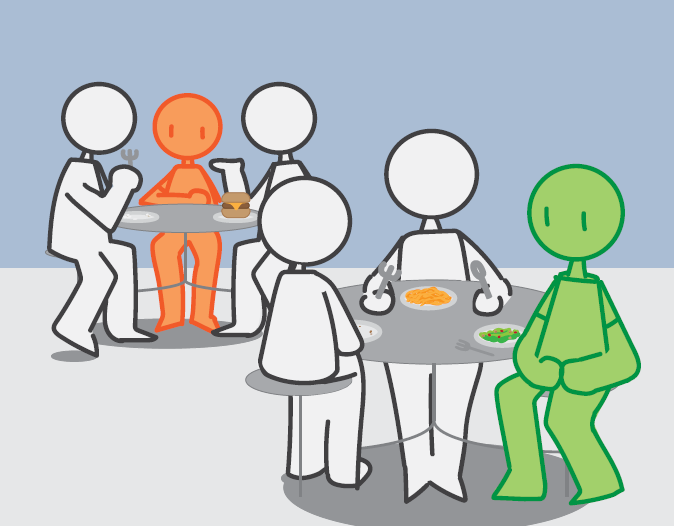
It began with skipping breakfast in the morning.
Then talking walks before and after lunch.
Then never finishing dinner.
Then weighing herself at the end of each day.
Before Jane* knew it, she was showing clear symptoms of anorexia.
“I became really underweight when I was in middle school,” Jane said. “It was really bad. Looking back now I was definitely restricting my eating and that’s why. I think I got really obsessed with the idea of achieving a certain look or, I guess, body. It became the only thing I ever thought about.”
How it begins
An eating disorder is a serious mental health condition characterized by severe, continuous disturbances in eating behavior and related thoughts and emotions. According to a study by Eating Disorder Hope, 2.7% of adolescents ages 13 to 18 will experience an eating disorder. Despite this, many cases go unnoticed or are dismissed.
For Jane, the danger with her eating disorder was not just the weight loss. Suffering from anorexia, she quickly took on destructive habits—skipping meals, obsessive body checking, counting calories—and made them part of her everyday routine.
“I don’t really think it had a specific look, [because] it became such a normal part of my life,” Jane said. “Looking at me, I acted normal.”
This normalization is part of what makes eating disorders so dangerous, and so common. When disordered behaviors blend into everyday life, they are rarely questioned by the people around them, or even the person experiencing them. Skipping meals becomes “being too busy,” excessive working out is “staying disciplined” and constant food rules are framed as “making healthy choices.” Over time, the disorder learns to hide in plain sight.
“I would find any way to get out of eating with my family, at group events, even with my friends,” Jane said. “I needed to find a way to explain why I wasn’t hungry around them.”
This invisibility is a common thread in eating disorders. While extreme cases are recognized, many people live with it for months or years without intervention.
This is how many eating disorders begin: not with a crisis, but with behaviors that slowly become routine. Despite restrictive eating being one of the most recognized behaviors, it represents only one part of a much larger spectrum.
Anorexia
Eating disorders can take many forms, each with their own unique behaviors, risks and misconceptions. Anorexia nervosa—one of the most common forms—is characterized by severe food restriction and an intense fear of gaining weight. However, not everyone with anorexia appears underweight. Atypical anorexia includes the same behaviors and psychological distress as individuals with anorexia, but occurs in individuals whose weight falls within or above what is considered a normal weight range. Because weight loss is often treated as a primary indicator of illness, many cases of atypical anorexia are overlooked.
Being diagnosed with atypical anorexia, Amy* struggled to recognize the severity of her restriction without the physical markers typically associated with anorexia.
“For the longest time, I didn’t feel like I had anything wrong with me because I wasn’t skinny,” Amy said.
[sentence]
“I think in the media, [anorexia is] portrayed as, ‘Oh, I want to be skinny, and I cry if I have to eat a cheeseburger,’ but that’s not how it is all the time,” Amy said. “It’s not always obvious or dramatic. It can look like someone just eating less than normal.”
Bingeing
For others, eating disorders involve cycles of consumption rather than restriction. Binge-eating disorder is marked by repeated episodes of eating large amounts of food accompanied by a sense of loss of control. Unlike overeating, these episodes are not driven by hunger, and are typically followed by shame or distress.
John* experiences binge eating, and feels that it is often minimized and misunderstood because it does not fit the narrow image many people associate with eating disorders.
“I’ll get these periods—sometimes it’ll last a week—where literally all I can think about is food,” John* said. “Genuinely, it’s on my mind 24/7. I feel like there’s a black hole in my stomach that keeps needing food, even if I feel sick.”
Unlike restrictive disorders, binge eating is inconsistent, and is often triggered by stress or other negative emotions. Episodes can come and go unpredictably, making it harder to recognize patterns or seek help.
“It’s honestly really inconsistent,” John* said. “I’ll feel fine for a week, and then out of nowhere I need to eat everything so bad. It’s more common when I’m stressed, [because] it relieves stress, but not always. It could be completely random too.”
Despite being the most common eating disorder in the U.S., affecting 2.8% of all adults at one point in their lives, binge eating is rarely discussed or understood.
“Most people don’t even know binge eating is a thing, or they confuse it with overeating,” John* said. “I grew up thinking for years that I just wanted to eat for no reason, and while I still don’t really get it, I have a name to put to what I feel.”
While having a name for an experience can be powerful, it does not erase the stigma that surrounds it. For many people who experience binge eating, the shame attached to their behaviors make it difficult to talk openly or seek help. Unlike restrictive eating, binge eating often occurs in secret, reinforcing the idea that it is something to hide, rather than a serious mental health condition.
“When it’s really bad, I get so embarrassed and frustrated [that]I’ll take it out on other people, because I don’t understand it,” John* said.
Bulimia
That same silence surrounds another commonly understood eating disorder: bulimia. Bulimia nervosa involves cycles of binge eating, followed by periods of compensatory behaviors—or “purging”—such as vomiting, extreme dieting or excessive exercising. While it is sometimes portrayed as a disorder driven by appearance, it is often accompanied by a state of anxiety surrounding food.
“I get really anxious when it comes to eating,” Sara* said. “I hate being around food, because I know what could come from it.”
Sara has had bulimia for over two years, in which she endures periods of intense binging, followed by purging, weekly. Since the beginning of her eating disorder, Sara has faced many health complications just from purging.
“No one talks about how it can physically affect you, like it f—s up your teeth, your breath, your face,” Sara said.
Across all types of eating disorders—anorexia, bulimia and binge eating disorder—a common pattern emerges: eating disorders thrive in secrecy. They are sustained by isolation, misunderstanding and the belief that one’s experience does not count as serious enough to deserve help.
This belief is only reinforced by how narrowly eating disorders are portrayed. Media representations often focus on extreme cases or a single stereotype—young, underweight and visually ill. When people do not see themselves reflected in those portrayals, they are more likely to dismiss their behaviors as temporary, manageable or not serious.
“[People think] that they’re a disorder for young people,” Amy said. “People act like it’s something you grow out of, or it’s immature to have, but it affects adults too. Also that it’s just anorexia, because it’s not.”
Other forms
Eating disorders exist on a much larger spectrum than most people realize. Other conditions such as Avoidant/Restrictive Food Intake Disorder, pica, orthorexia, and Other Specified Feeding or Eating Disorders often go unrecognized because they do not fit the stereotypical image of what eating disorders look like.
Another factor that complicates recognition is the blurred line between disordered eating and eating disorders. Disordered eating refers to unhealthy eating behaviors that may not meet the criteria for a clinical diagnosis but still pose a risk to an individual’s physical or mental health. These behaviors can include skipping meals, strict food rules, fasting or cycles of restricting and bingeing. According to a National Library of Medicine study, 22% of children and adolescents show signs of disordered eating.
“Who’s to say what’s normal dieting and what’s restricting yourself,” Amy said. “I think a lot of people end up with eating disorders because they go down that rabbit hole.”
The confusion between what habits are and are not harmful can lead many people to overlooking just how dangerous their behaviors are.
Diet culture plays a significant role in this normalization. Weight loss is frequently praised, regardless of how it is achieved. Restrictive habits are framed as discipline, and early warning signs are easily overlooked.
“People would comment that I looked good because I was losing weight, but no one thought that it could’ve been in an unhealthy way,” Amy said.
This praise can unintentionally reinforce harmful behaviors, making them harder to break. When restriction is rewarded socially, it becomes even more difficult for individuals to recognize that their relationship with food has shifted into something harmful.
In addition to social reinforcement, many eating disorders are fueled by feelings of overwhelm. Food becomes something to regulate in order to feel in control, even as their behaviors begin to cause harm.
“I think eating disorders [usually come] from a place where students want some type of control,” mental health counselor James Bartlett said. “It’s one aspect of their life they can have control over, when they might feel out of control in other areas.”
Unlike many other mental health conditions, eating disorders involve something essential to survival, making them especially dangerous.
“It’s hard, because it’s unlike anxiety, because you have to eat every day, so you can’t avoid it,” Bartlett said.
Recovery
Because food is unavoidable, recovery is not as simple as eliminating a trigger. Instead, individuals with eating disorders must relearn how to interact with food in a healthy way—a process that can be slow and uncomfortable.
For some students, recovery begins when someone else notices their harmful behaviors.
“My parents caught on to what was happening, and they sat me down and talked to me,” Jane said. “And obviously, it didn’t happen in one day, but they helped me create a diet plan, and watched over more of what I ate. I think having my parents talk to me, it made me realize that someone actually was watching me and noticing my behavior. Having an eating disorder can feel really lonely, and while you don’t want people to know, at the same time you really do.”
Recovery looks different for everyone. For some, it involves therapy and medical support. For others, it starts with open conversation and gradual changes. For many students, recognizing their eating disorder is only the first barrier—seeking treatment presents a new challenge altogether.
The stigma surrounding mental health care, particularly more intensive treatment options, such as inpatient programs or mental hospitals, prevents many people from reaching out for help. These facilities are often portrayed as last resorts, reinforcing shame and fear rather than understanding. A Yale School of Medicine study found that fewer than 30% of people with an eating disorder reported seeking help from a counselor or psychologist.
“I didn’t want to go somewhere,” Sara said. “It was more a fear of missing out, being isolated from my friends, and I also didn’t think I needed it. I’ve heard that places like that honestly make it worse [rather] than better.”
This mindset reflects a broader misunderstanding of recovery. Rather than a straight path, recovery is often nonlinear, with multiple setbacks.
“When you’re disordered, you learn to memorize calories in things, and it’s pretty impossible to forget,” Jane said. “So sometimes I have to sit with how many calories I’ve eaten, because I know how many, but I can’t do anything about it.”
Unlearning these habits can be one of the most difficult parts of recovery. Eating disorders are not just patterns of behavior, but rather deeply ingrained thought processes and routines. For many people, recovery means learning to eat without calorie counting, fear or anxiety, and learning how to sit with discomfort without turning to restriction, binging or purging.
These learned behaviors can often extend into areas outside of food. Many individuals develop rigid routines, such as avoidance of social situations or compulsive habits around exercise, which can be difficult to break.
“It’s so easy to not eat for hours at a time, or to spend all your time exercising or out on walks [that] it becomes your norm so quickly,” Amy* said. “It’s almost like you have to set reminders to eat a certain amount. It’s just as hard as going against your instincts to eat a certain amount.”
The next step
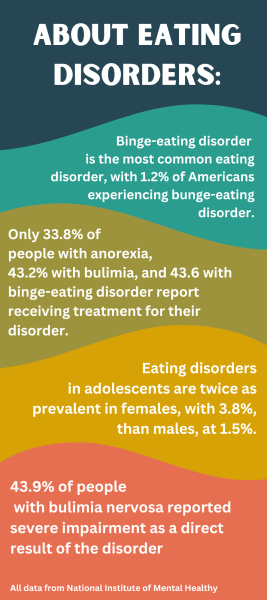
The reality is that eating disorders thrive in silence. Despite being the mental illness with the highest mortality rate—resulting in an average of 10,200 deaths each year—they are not always acknowledged, or treated with the same urgency as other conditions. Jane believes that breaking that silence by talking openly, recognizing the warning signs and challenging the stigma around treatment is critical.
“There are resources; I just wish eating disorders themselves were more talked about like depression and anxiety
are,” Jane said. “If it was more common I think people would be less afraid to talk about it, or realize they have it. Some people don’t even know t
heir habits are unhealthy until they’re in too deep.”
By expanding conversations beyond stereotypes and acknowledging how easily disordered behaviors can become normalized, there is an opportunity to intervene before actions become harmful. Eating disorders do not begin with extremes and they do not require someone to reach a breaking point to be taken seriously. Awareness, education and access to support can make the difference between silent suffering and recovery.
“It’s so easy to think that there’s no light at the end of the tunnel, that you’ll be stuck with [an eating disorder] forever, but that’s not true,” Amy said. “Once you get out of that mindset, you’ll realize that you deserve to heal, and you did the whole time.”
*Names changed for privacy