Excerpts, analyses, arguments. It is easy to get lost looking at the messy oceans of words from centuries ago, and for students today, it is getting even harder.
A PBS news video reports that one in every three high school seniors do not have the skills to comprehend the meaning in a given text. With high school lessons building off the concepts taught earlier, a small misunderstanding of material from years before can spiral into critical struggles in later courses.
“I have taught students who have passed from grade to grade, but genuinely cannot read or begin to understand how to break down ideas,” English teacher Brittany Brown said. “When it comes to reading, they can’t absorb understanding from a text, even with specific instructions into the background of why it was written.”
In the past few years, there has been a noticeable difference in performance between students, primarily demonstrated through what classes students elect to choose. Students in all levels, from standard to Advanced Placement, struggle with reading comprehension. Basic understanding of schoolwork has been lowered by the pandemic, the temptation to use artificial intelligence and distractions such as social media.
Pandemic
The common trend of students falling behind in class can be tied to the 2020 pandemic. The lack of structured, in-person education for months to years on end created a gap between those who responded well and those who did not. A series of Harvard studies show that in multiple schools around the country, modern-day students would need to learn 50% faster for three years just to catch up to pre-pandemic students.
“I started trying less on my work, [but I’m] trying to work better on that,” freshman Kaylan Atkinson said. “I stopped talking a lot in school.”
Atkinson was in third grade during the pandemic, and was among the multitude of students required to transition to online schooling. This new way of learning became the norm, and it was found to be considerably easier than traditional education. The lack of time to prepare and adapt left schools unsure of the best path to help their students.
The difficulties that came with online schooling did not lie in the work itself, but the lack thereof. Students could be completely off-task during class video meetings and would have endless time to find workarounds to completing assignments, which made it harder to catch up when schools opened up again.
It is not just the mental effects of the pandemic that have students struggling to keep up, but the physical removal from schools, which has made it harder for students to learn in classrooms. Numerous reports show that students are having a harder time than ever focusing in classrooms during lessons.
Schools still struggle to recoup losses from 2020. The repeated trend of low ELA subject scores shows students still struggling to meet class standards. English teacher Cassidy Ward sees this decline every day in class.
“[With] the reliance on technology and online classes, it’s become more [about] getting the work done instead of reading it, understanding it and learning what [students are] supposed to learn,” Ward said. “It’s a checklist of assignments.”
The focus of high school for many students is simply not what it was before the pandemic, with so much time away from an educational environment having lasting impacts on students that could not have been anticipated.
Artificial Intelligence
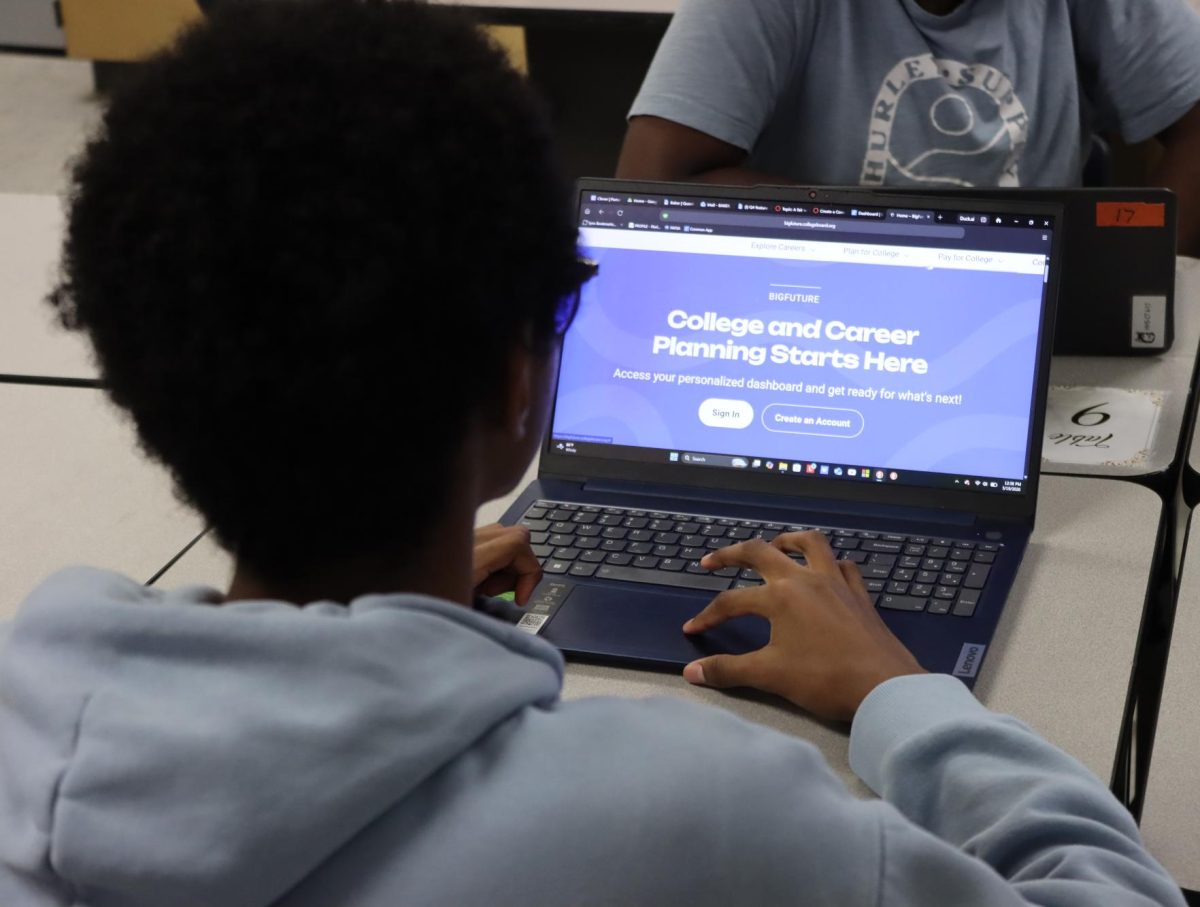
Many students see schoolwork as an obstacle to things they truly want to do, rather than as an opportunity to enhance their learning. With search engines and artificial intelligence, students have tools that remove the need to actually develop the skills schoolwork aims to help them build, which has caused many to outsource their thinking.
With some schools facing up to 86% of students using AI for studies, it is no wonder that students are less attentive in class. Though sometimes inaccurate, Artificial Intelligence offers complete breakdowns, practice problems, study guides and tutoring to students. Students seeking AI as a means to enhance or replace their education can be cited as one of many reasons for a decline in classroom performance.
“I think our future is cooked,” senior Jayden Nguyen said. “People do not know how to do the most basic [stuff]. I’m like, ‘What are you doing?’”
The key to artificial intelligence as an educational tool is to use it to enhance learning, not hinder it. Practice tests, flashcards and summaries are among many ways the machine can help students understand material.
“AI usage will continue to impact education, but part of the problem is that students don’t understand how it could be used to help them learn and think,” Brown said. “The temptation for students to look for outside help has become too great.”
The ease of access to ways to complete work without doing any of it makes it increasingly difficult for educators to provide meaningful teaching to students. When a single prompt can replace a whole writing assignment, many students are tempted to leave the human work to AI and search engines.
“I have had my students ask me what the point of doing something [is] if AI can just do it for them,” Brown said. “As teachers, we are encouraged to teach students how to ‘use AI ethically,’ but aren’t provided the time or resources to build this into our curriculum. Until this happens, most students will continue to use AI to the detriment of their own possible success.”
Social Media
Online content has become the focal point of teenage attention in the modern age. The appearance of infinite attention-grabbing videos at the disposal of the viewer makes it easy to lose track of time.
This time could have been allocated into many other areas of life, such as cooking, working on homework and even productive rest in naps or medication. A strong case can be made for the connections that social media can build among students, but when unregulated, it can prove a hindrance.
A study conducted by Tulane University shows a link between using social media and drops in performance, mainly attributing the decline to students being distracted from their work or studies.
Social media consumption varies between individuals, with some using it as a news source, while others focus on its entertainment value. Some may face few harmful effects from online platforms while others find themselves addicted.
“I think social media access is fine,” Nguyen said. “It’s just [that] some people aren’t mature enough to use it. But that just comes from personal matters, not really social media.”
Short form content, saturated colors and captivating audios all combine to keep students on their device for as long as possible, taking away time that would either be used for rest, studying or sleep.“I feel like it has students transfixed on the content that is rapidly being produced,” Brown said. “Attention spans are shorter, and students often ask me if they can use their phones because they’re done.”
The big picture
Consistent reports of students continuing to struggle nationwide, years after schools and governments have supposedly recovered from the pandemic, continue to concern educators.
“When [students have] reached the high school and pre-college level, the literacy gap is at its largest average,” Brown said. “At this point, it is difficult to close that gap without intentional, intensive reading practice and exposure.”
With countless algorithms, influencers and advertisers all vying for teenage attention every second these apps are open, the chances of students setting the easily digestible entertainment aside in favor of more complex novels grow slimmer by the day.
“[Student reading levels] make [me] take a second look at some things that I’ve done before, and scaffold it a little bit differently, thinking, ‘Okay, I have to piece this differently than I have in the past, [or] I have to front load now with more information than I have before, just to make sure they’re on the level they should be,’” Ward said.
However there is still hope for those who wish to reach high levels of reading proficiency in their testing and everyday lives. Public libraries, online resources and willing teachers are present throughout the school and nation, and all provide the necessary resources to enrich young minds.
“I don’t think this trend in student literacy will continue permanently; however, I don’t think things will change immediately,” Brown said. “Fortunately, many parents, lawmakers, and educators have started to notice the consequences of a population that struggles with literacy entering the workforce and college, so, as a result, changes are attempted to be made to remedy [literacy problems] for future generations.”