Across local parks and gyms, students are organizing practices, drawing up plays and drilling in fundamentals to younger athletes.
The pursuit of a full scholastic Bright Futures scholarship requires 100 service hours. These hours can be gained from community involvement and volunteering. A select few get their hours at football fields, local gyms and in martial arts studios, stepping into leadership roles as youth coaches. What begins as just a scholarship requirement often turns into something deeper: mentorship, patience and growth as students and leaders.
Passing it down
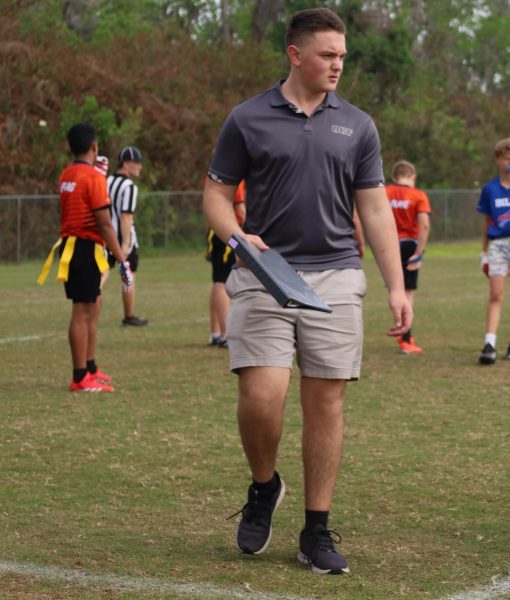
For senior Job DeMarino, his path to coaching began by looking up to the mentors he grew up with.
“What originally motivated me to start coaching flag football was growing up, I had a lot of young adult mentors, especially through sports, and wanted to be that to somebody else, just help them become better people, better athletes,” DeMarino said.
Although the Bright Futures scholarship is a typical motivation for community service hours, DeMarino viewed it differently.
“I believe when I started coaching, like Bright Future hours were kind of a secondary issue, like an added bonus to being able to do something I already really loved,” DeMarino said.
DeMarino puts a lot of time into the job, even when he is not on the field. He structures practices with a purpose in mind. This can be seen with offensive days focused on one-on-ones, passing the football, setting up plays correctly and enhancing offensive fundamentals, such as route running and catching. Defensive days focus primarily on setting up coverages and teaching his team where they should be in order to stop their opposing peers. These days also focus on enhancing defensive fundamentals, such as flag pulling and covering receivers.
Beyond the drills, DeMarino heavily leans upon his team’s camaraderie. However, being in high school presents some challenges to coaching his team.
“There’s a tendency… where they don’t take you as seriously as they would take a dad coaching,” DeMarino said.
This made him have to take another angle at leadership, attempting to build up his credibility and ensure that the team knew he was in charge. This came with DeMarino and his assistants running in drills with his players to demonstrate. Running in scrimmages against his own players to demonstrate what good fundamentals look like. DeMarino, a 3 year varsity letterman for football, had the credibility.
“I think coaching really made me realize that to be a good leader, you have to be willing to do the things you’re asking of your players…” DeMarino said. “A true leader gets down with his players.”
Even after he gets his Bright Futures hours, DeMarino plans to keep coaching.
“I would absolutely continue coaching if I didn’t need the hours.”
Building leaders
For senior Gavin Simmons, football culture has become second nature.
“I’ve played football for most of my life,” Simmons said. “I’m just used to the culture and I want to take what I’ve learned and pass it to the next generation.”
Coaching helped reshape Simmons’s understanding of what it takes to be a coach. Simmons’s practices begin with stretching, followed by passing drills and defensive work. But keeping the younger players focused can be the trickiest part. He found out that by earning the respect of his team made coaching significantly easier.
“It’s more of the respect part of leadership,” Simmons said. “You have to make them get them to respect you or you’re not gonna be able to lead them.”
Even when his team didn’t win, he found fulfillment with his work. Part of the job with coaching is making sure a team doesn’t change course after a loss or two. Simmons had to make sure his team was constantly moving towards getting better and fighting for more wins. Simmons noted that even after these struggles, he was able to coach the team back on track for the following week.
“Everyone was smiling because they knew they played as good as they could… and that’s the most rewarding thing,” Simmons said.
Strategy and cooperation
Senior Carter Richburg coaches younger age groups within the same flag football league as DeMarino, where the responsibility leans more onto the coach.
“The responsibility lies on you to create a good scheme to win,” Richburg said.
Balancing humor with discipline is key. Richburg noted that his first season coaching came with some challenges, the biggest one being that he needed to make sure the kids bought into what he was trying to implement and respected him as a coach.
“I try to make the kids like me.. But I also try and remind them I’m still their coach,” Richburg said.
Beyond football, he hopes players carry that cooperation into their adult lives.
“I just really hope they learn how to cooperate because [it’s] a very important skill later in life,” Richburg said.
As the season progressed, Carter was surprised to find how much he enjoyed coaching. As players started to buy into the team, he was able to make his vision come true. Richburg enjoyed the routine practices and energetic Saturday morning games that he was able to take on with his new team.
“It really became a lot of fun… just things like that, the little things,” Richburg said.
Patience in practice
Not all coaching happens on a football field. Senior Drake Adkins instructs karate, where progress for the kids is individual rather than as a team.
“I’d say it differs from team sports because it’s more individual,” Adkins said. “Kids learn kind of their own stuff at their own pace.”
Teaching forces Adkins to be precise, as karate as a sport requires perfection. Adkins must draw onto his own experiences and training when dealing with his players.
“I have to really understand every single tiny technique,” Adkins said.
More importantly, instructing karate to younger children requires patience. The quest to perfection is long and arduous, maintaining the expectation of patience is necessary to stay focused on advancing their belt color. His advice to future coaches reflects that lesson.
“Be patient… everybody learns at a different speed… patience is definitely key and it helps everybody learn more,” Adkins said.
Adkins, who started instructing karate for Bright Futures hours, was able to build upon his success and connection with his players to ultimately get a paid job instructing. Adkins especially loves the lessons he’s learned from his time coaching, one being the patience required to successfully coach.
The Impact
From championship runs to demonstrating to distracted 10-year-olds, student coaches are discovering that leadership is built and earned through service and respect. While achieving a 100% Bright Futures scholarship only requires 100 hours, the lessons extend much farther beyond paperwork.
Coaching challenges students at the school to communicate clearly, earn respect and guide others through setbacks and success. Ultimately, these journeys lead into a passion that many find true fulfillment in, and leave impacts on younger athletes that truly lasts.